



Cost Saving, Eco-friendliness & Quality Upgrade All in One — Xinda Special Cold Box Resin for Aluminum Casting
2026-07-20 09:15Against the backdrop of the full implementation of the dual-carbon policy and the comprehensive upgrading of high-end lightweight manufacturing, aluminum alloy, boasting lightweight and high-strength properties, has become a core substitute for steel in new energy vehicles, rail transit, aerospace, wind power, construction machinery and other sectors. Demand for complex integrated castings such as motor housings, battery pack brackets, chassis subframes and engine cylinder heads is surging continuously.
As a mainstream production solution for aluminum alloy castings with intricate inner cavities, the cold box core making process features outstanding advantages including high forming precision, fast curing speed and low production energy consumption. Currently, cold box resins in the industry are being iteratively upgraded toward low VOC emissions, low fume generation, excellent shakeout performance, low addition dosage and high core strength. Nevertheless, conventional universal cold box resins fail to adapt to the low-temperature pouring working conditions of aluminum casting, accompanied by three long-standing production pain points that restrict production capacity expansion and compliance with environmental protection standards.
I. Three Traditional Process Difficulties in the Aluminum Casting Industry
The pouring temperature of aluminum alloy is only around 700°C, much lower than the 140°C high pouring temperature for cast iron. The resin bonding film cannot be fully decomposed at high temperatures, triggering a chain of associated problems:
Poor Shakeout Performance of Cores, Resulting in High Sand Cleaning Costs
The high pouring temperature of cast iron completely burns off the resin film for easy shakeout. However, the insufficient temperature of molten aluminum leaves high residual strength of the resin. Molding sand stubbornly adheres to water channels, air passages, deep cavities and narrow slits. Manual sand cleaning is time-consuming and labor-intensive, slowing down the delivery efficiency of the entire production line.
Heavy Fume Generation During Pouring, Causing Dual Losses to Environmental Compliance and Equipment
Most aluminum casting lines adopt open or semi-open pouring stations. Conventional resins release massive irritating fumes under heat. Such fumes not only make it hard to meet workshop environmental emission standards and harm operators’ physical health, but also continuously stain molds and tooling. This increases working hours for polishing, cleaning and maintenance, driving up overall production costs.
Mutual Contradiction Between Core Strength and Environmental Performance, Unable to Achieve Both
Complex aluminum casting cores feature uneven wall thickness and slender structures, imposing stringent requirements on room-temperature strength and storage strength. The common industrial workaround is to increase resin addition rate to guarantee core strength. Yet higher resin dosage simultaneously boosts gas evolution, impairs shakeout performance and amplifies fume emissions, creating an unavoidable vicious cycle plaguing the whole industry.
II. Xinda Cold Box Resin Specially for Aluminum Casting: Four Core Performance Breakthroughs Breaking Industry Bottlenecks
Targeting the pain points unique to low-temperature pouring conditions in aluminum casting, Xinda has independently developed a dedicated cold-box resin for aluminum casting. It simultaneously achieves four superior properties: low addition dosage, high core strength, excellent shakeout and low fume output, resolving the performance trade-off dilemma of conventional resins.
Ultra-low addition dosage cuts gas and fume generation at the source
Commercially available standard two-component cold-box resins generally require an addition rate of ≥1.0%, while Xinda's product only needs 0.65% to meet full core-making requirements. The drastically reduced resin consumption directly lessens thermal decomposition byproducts from raw materials, fundamentally curbing the baseline volume of gas evolution and fume emission.
High strength maintained at low dosage, lowering core breakage and scrap rate
With optimized formulation of an innovative polymer bonding system, the overall core strength of our product is 15%–20% higher than competing products at the low 0.65% addition rate. Slender thin-walled and large-size complex cores resist cracking and damage during transportation, mold closing and pouring, cutting core-making scrap and stabilizing casting yield.
Specially formulated for low-temperature molten aluminum with superior shakeout to simplify shakeout operations
The formula is specially modified for 700°C low-temperature pouring conditions, greatly improving the thermal decomposition capacity of the resin bonding film at low temperatures. The core shakeout rate exceeds 68% after pouring. Molding sand inside deep cavities, intersecting water channels and narrow interlayers loosens and falls off automatically, drastically shortening manual vibrating and digging sand procedures and greatly boosting productivity at the shakeout station.
Dramatically reduced on-site fume for improved workshop working conditions
Combining low addition dosage with a low-fume molecular structure design, on-site tests show pouring fume is reduced by 30%–50% compared with rival products. Irritating odors in the workshop are greatly mitigated to deliver a healthier working environment for frontline staff. Meanwhile, mold blackening and carbon deposition are slowed down, extending tooling cleaning intervals and lowering equipment maintenance costs, easily complying with stringent environmental regulations.
III. Practical Customer Application Cases – Performance Advantages Verified by Actual Test Data
Case 1: A Large Manufacturer of Aluminum Cast Components
Comparative test data against competitive resins under identical core-making and pouring conditions:
Core strength increased by 17%
Gas evolution reduced by 0.6ml/g
Shakeout performance improved by 6%
On-site pouring fume cut by approximately 30%
Case 2: A New Energy Vehicle Chassis Casting Plant (Low-pressure Casting for Subframes)
Mass production test results of intricate thin-wall cores for chassis parts:
Core strength improved by 15%–20%
Total gas evolution decreased by 10%–15%
Shakeout performance boosted by 10%
Pouring fume reduced by as much as 50%, significantly easing the workshop's environmental compliance burden
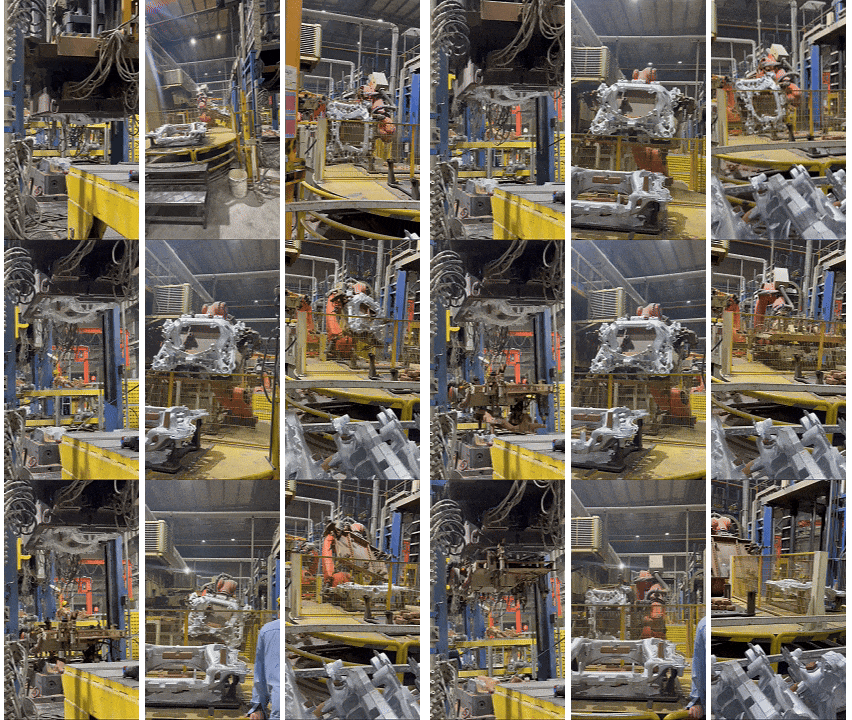
The global manufacturing sector is accelerating its green transformation. Demand for integrated aluminum alloy castings keeps expanding in high-end industries including new energy vehicles, aerospace, rail transit and wind power equipment. The market has set four mandatory standards for cold box resins: low addition dosage, high core strength, low fume and low VOC emissions, as well as excellent low-temperature shakeout performance.
It used to be challenging to satisfy all four indicators simultaneously. However, Xinda's special cold-box resin for aluminum casting achieves balanced multi-dimensional performance. Driven by three major demands — stricter environmental supervision, corporate cost reduction & efficiency improvement, and lightweight & high-precision casting production — this resin delivers multiple benefits at once: lower resin material cost, less labor input for shakeout work, extended mold service life, improved workshop environmental conditions and higher casting yield. It serves as an eco-friendly and high-efficiency binder solution tailored for high-end aluminum casting manufacturing.