



How Foam Ceramic Filters Drive Superior Casting Quality and Higher Efficiency?
2025-12-19 13:05Inclusions are one of the most common casting defects. Many processes in casting production are designed to reduce inclusions, such as careful selection of furnace charge, removal of slag from the molten metal surface before pouring, covering the ladle with slag-collecting agent, designing the ladle as a bottom-pouring or teapot-shaped type, making the gating system closed, and installing slag collection bags and slag collection troughs in the runner. Molten metal filtration technology was developed in the 1970s and was first applied to aluminum alloys because aluminum alloys have a low melting point, and the density of the alloy and its oxides is almost the same, making it difficult for inclusions to float. The first generation product was woven filter screen; the second generation product was extruded straight-hole filter screen; and the third generation product was foam ceramic filter.
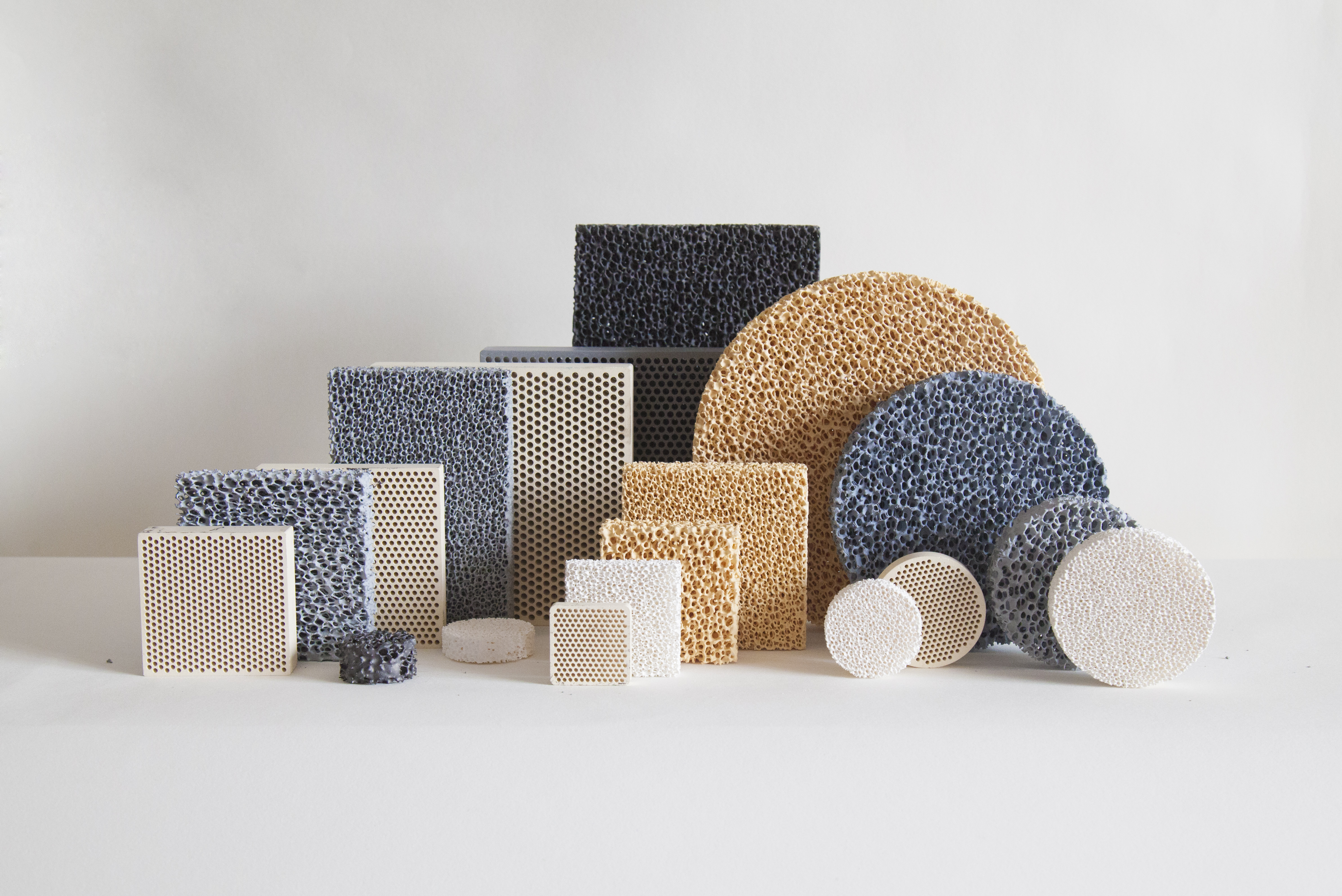
Ceramic foam filters, or CFF for short, are typically made by filling polyurethane foam with ceramic slurry, then extruding the slurry. The remaining ceramic material, surrounding the foam fibers, is then sintered at high temperatures. The polyurethane decomposes under heat, leaving behind a foamy ceramic product – the ceramic foam filter. This type of filter can be used with various casting alloys, and the product is commercially available. This filtration technology has been widely adopted in industrialized countries. XINDA's ceramic foam filters have improved the mechanical properties of castings and reduced defects such as porosity and inclusions.
Using foam ceramic filters saves metal
To reduce inclusions during casting, efforts are often made to optimize the gating system, aiming to trap inclusions in the molten metal before they enter the mold cavity. If the casting has severe inclusions, every effort is made to increase the height and length of the gating runner and the volume of the slag collection pot, thus reducing the casting yield. For example, a XINDA partner company producing ductile iron front wheel hubs had a yield of 65.3% before using a filter, which increased to 71.5% afterward. This saving of 6 percentage points of molten iron was achieved simply by reducing the weight of the risers and gating gates. Based on the company's annual production of 80,000 tons of ductile iron, this translates to a reduction of 5,000 tons of molten iron melted annually, significantly lowering production costs while maintaining capacity. This is why the company chose to cooperate with us long-term.
Reduced Casting Scrap Rate
Engine cylinder heads are critical castings with complex structures and thin walls, requiring a tight seal. Therefore, their pouring temperature is higher than that of ordinary castings, making it less prone to inclusion buildup under the same conditions. In the past, although numerous slag-blocking measures were designed into the gating system, such as closed systems and flow-restricting devices, the scrap rate due to slag, sand, and pores remained high, consistently around 12%. After adopting the XINDA filter, pouring time became stable, leakage significantly decreased, and the scrap rate due to slag, sand, and pores has remained stable below 3% for several years. In the production of fixed-end support and rear-mounted castings, the filter was placed on the socket of the sprue. After 1000 trials and 4000 production runs, compared to the unfiltered castings produced during the same period, the use of the XINDA filter significantly reduced the scrap related to inclusions.
Improved Mechanical Properties of Castings
Non-metallic inclusions disrupt the continuity of the metal matrix and create stress concentrations at their edges, thus reducing mechanical properties. Inclusions distributed at grain boundaries are prone to intergranular fracture. Using XINDA foam ceramic filters can remove inclusions smaller than 2μm from molten metal and also remove gases, improving metal purity and enhancing physical and mechanical properties. Using filters during the production of gray cast iron parts allows graphite and metal to nucleate at lower temperatures, resulting in reduced graphite length, increased quantity, and more uniform distribution after solidification. This reduces the cutting effect of graphite on the matrix, leading to finer and more uniform pearlite distribution. Under the same conditions, HT150 showed a 16% increase in tensile strength, a 5.4% increase in flexural strength, and a 10% increase in hardness.
Foam ceramic filters are driving the upgrading of the foundry industry
From cost control to quality improvement, from ordinary castings to high-precision parts production, foam ceramic filters are propelling the foundry industry towards high efficiency, high quality, and environmental sustainability with their irreplaceable advantages. Whether it's reducing production losses or enhancing product competitiveness, foam ceramic filters are indispensable.
Xinda has focused on the R&D and production of foam ceramic filters for many years, helping numerous domestic and international clients in the foundry industry improve their casting capabilities. If you have any needs, please feel free to contact us.