



How to Apply Sand Mold (Core) Coatings Effectively?
2026-04-17 09:18In the casting production process, the quality of the working surface of sand molds (cores) in direct contact with molten metal exerts a critical influence on casting quality. Coating the surface of casting molds or sand cores is an economical, practical, and highly effective method to improve casting surface quality. During pouring, the coating layer lies between the molten metal and the mold, regulating and optimizing the interfacial contact state and high-temperature reactions between the molten metal and the sand mold (core), thereby preventing the formation of various casting defects. In recent years, with increasingly stringent requirements for casting quality, the production and application of high-quality coatings have received widespread attention both domestically and internationally.
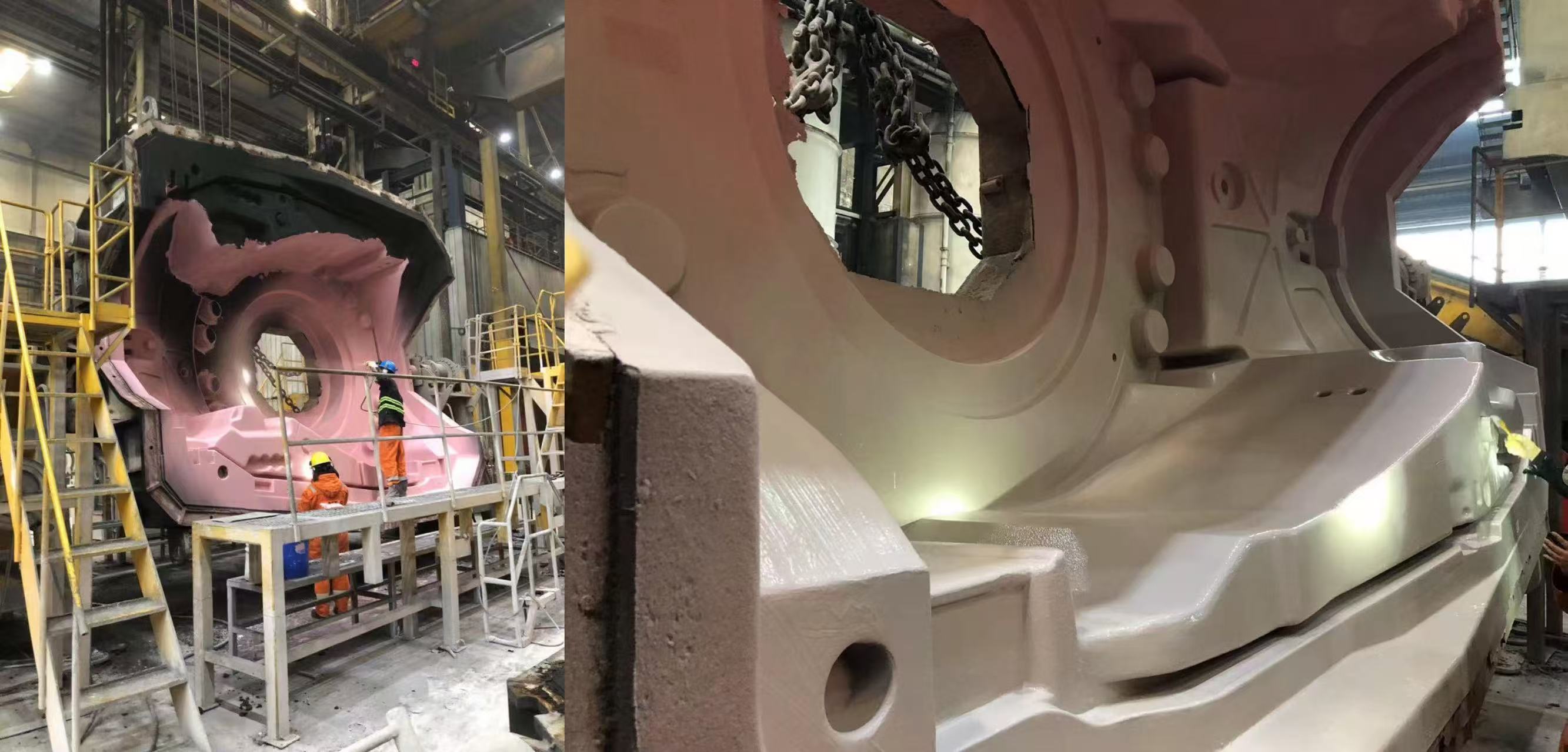
I. Functions of Coatings
1. Improving Surface Quality
Coatings prevent mechanical penetration, enhance casting dimensional accuracy, and achieve desirable surface roughness. With a sound coating layer, the surface roughness of castings can be reduced from Ra = 25–50 μm (without coating) to Ra = 3.2–6.3 μm.
2. Preventing Chemical Penetration
For castings poured at high temperatures with substantial section thickness, high-quality coatings with excellent high-temperature chemical stability and special additives can prevent chemical reactions between molten metal and sand molds, avoiding the formation of penetration layers and delivering smooth casting surfaces.
3. Enhancing Mold Surface Strength and Reducing Defects Such as Scabbing, Sand Erosion, and Sand Inclusions
Sand molds (cores) with low surface strength (e.g., clay green sand molds and water glass sand molds requiring good collapsibility) or binders with low thermal decomposition temperatures (e.g., various organic binders) are prone to scabbing, sand erosion, and sand inclusions during pouring. Coatings with superior strength and refractoriness help mitigate or eliminate these defects, extending the temperature application range of organic binders.
4. Controlling Casting Cooling Rate to Prevent Shrinkage Cavities, Porosity, Cracks, and Other Defects
By using refractories with different thermal conductivities and adjusting coating thickness, the heat transfer rate from molten metal to the sand mold can be controlled, thereby regulating the casting cooling rate and preventing cracking and shrinkage-related defects.
5. Shielding Harmful Elements to Avoid Gas Porosity, Carburization, Sulfur Pickup, Local Nodularization Deterioration, and Other Defects
In casting with nitrogen-containing furan resins or furan resin sands cured with benzenesulfonic acid and similar agents, steel castings are susceptible to subcutaneous porosity; low-carbon stainless steel castings may suffer sulfur pickup and carburization; and ductile iron castings may experience local nodularization failure. A dense sintered coating acts as an effective barrier against N, S, and C from the sand mold (core) reacting with molten metal, eliminating subcutaneous porosity, carburization, sulfur pickup in steel castings, and local nodularization deterioration in ductile iron castings.
6. Modifying Surface Composition, Microstructure, and Properties of Castings
Specialized insulating and chilling coatings alter the cooling and crystallization rates of molten metal, producing inverse chill and white iron microstructures on casting surfaces to achieve desired hardness and mechanical properties. Adding metal powders of the same composition as the poured metal or with similar lattice constants to coatings provides nucleation sites for grain refinement.Incorporating metal elements or alloy powders with melting points slightly below the pouring temperature of molten metal enables surface alloying of castings through liquid diffusion. When adding metal elements or alloy powders with melting points higher than the pouring temperature, they do not alloy with the casting surface but embed within it, imparting special surface properties such as wear resistance.
Taking sand casting as an example, rough statistics show that casting cleaning costs typically account for approximately 30% of total production costs. The use of coatings reduces cleaning costs by more than 10%, while coating and application expenses represent only about 5% of production costs. Consequently, coatings lower overall casting production costs by more than 5% — excluding additional benefits from reduced rejection rates and improved mechanical properties.
II. Methods for Selecting Sand Mold (Core) Coatings
| Mold/ Core Type | Recommended Coating Types |
|---|---|
| Clay-bonded green sand molds | Alcohol-based coatings, high-solids water-based coatings |
| Oven-dried or surface-dried clay-bonded sand, water glass sand, resin-bonded sand, and oil-bonded sand molds | Water-based coatings |
| CO₂-hardened and self-hardening water glass sand molds | Alcohol-based coatings, high-solids water-based coatings |
| Gas-hardened and self-hardening resin-bonded sand molds | Alcohol-based coatings, high-solids water-based coatings |
III. Precautions for Coating Application
1. Stirring and Dilution of Coatings
Coatings must be thoroughly stirred before use, then diluted with an appropriate amount of solvent to the required viscosity based on actual conditions. Lower viscosities are recommended for spraying, dipping, flow coating, or for sand molds with low permeability and strength; higher viscosities are suitable for brush coating or sand molds with high permeability and strength.
2. Coating Thickness
An excessively thin coating layer fails to deliver satisfactory casting surface quality even with excellent coating performance, while an overly thick layer causes unnecessary waste. Coating thickness should be minimized on the premise of ensuring anti-penetration performance, to conserve materials and improve coating crack resistance.General coating thickness ranges from 0.15 to 1 mm, and 1–2 mm for extra-heavy castings. Smaller values apply to cast iron parts, while larger values are used for cast steel and cast copper parts.The thickness per application should not exceed 0.3 mm. Thick coatings require multiple passes: the first layer must be semi-dried (water-based) or ignited, dried, and cooled to room temperature (alcohol-based) before re-coating.
3. Coating Curing
Water-based coatings should be applied before drying or surface drying of water glass sand molds (cores). Hot-curing resin sands and oil sands are generally coated after drying, utilizing residual heat for drying or undergoing secondary baking. Clay dry molds (cores) or surface-dried molds (cores) can be coated either before or after drying.Drying temperatures for water-based coatings range from 100 to 450 °C. When surface-drying with torches, gas, or oxy-acetylene flames, avoid concentrating heat on localized areas to prevent overburning of binders.Alcohol-based coatings must be ignited and dried promptly after application to prevent excessive solvent penetration and evaporation. If ignition fails or combustion is incomplete due to prolonged standing, a small amount of alcohol may be sprayed onto the coating to assist combustion. For large sand molds (cores), local drying may be adopted.
4. Coating Storage
Water-based coatings should be protected from direct sunlight and freezing during storage. Alcohol-based coatings require sealed storage, fire prevention, and moisture protection.
Furthermore, to achieve effective coating performance, the sand mold (core) substrate must possess a relatively smooth surface, uniform compaction, and sufficient strength. Otherwise, application will be difficult, and the coating may crack or peel.
In conclusion, selecting the right coating and applying it properly is key to achieving high-quality castings. Xinda Casting Coatings provide reliable, tailored solutions for various sand mold systems, helping you minimize defects, reduce cleaning costs, and boost production efficiency.