



Prevention of Common Defects in Furan Resin Sand Castings
2026-05-22 09:431. Blowholes and Pinholes
Furan resin sand features good air permeability yet high gas evolution compared with inorganic molding sand, making gas defects prone to occur.
Causes
Excessively fine raw sand reduces air permeability. Standard grain size: 30/70 mesh; moisture content of raw sand below 0.2%.
Poor coating quality or incomplete drying leaves residual moisture in molds and cores.
Improper reclamation of used sand leads to excessive loss on ignition and ultrafine powder content, raising gas evolution and lowering air permeability.
Molds and cores are not fully cured before pouring.
Unreasonable gating design, slow pouring speed, insufficient metallostatic head and defective core venting layout.
Improper operation: neglected venting design, disconnected vent passages, blocked vents, excessive coating accumulation, blocked core heads, intermittent pouring and unfilled gating system.
Preventive Measures
Add resin and hardener in standard proportion. Adopt low-nitrogen resin with high furfuryl alcohol and low urea content. Select suitable hardener according to seasons and minimize binder dosage. Complete curing before mold closing and pouring. Nitrogen content in resin shall be under 1% for steel castings and 2% for iron castings. Add 0.3%-2% silane by resin mass to enhance bonding strength and cut resin consumption.
Use low-volatility coating with Baume degree above 30. Solvent moisture in coating shall not exceed 5%. Conduct flame drying before mold assembly.
Curing time varies with temperature, humidity and additives. Molds require 6-8 hours curing and cores are best used the next day. Stripping time shall be no less than 20 minutes.
Loss on ignition of reclaimed sand for iron castings ≤3%, ultrafine powder ≤0.8%. Keep sand-metal ratio below 3 by reducing sand consumption and applying hollow frames.
Maintain steady continuous pouring and ignite vents to exhaust gas timely.
Install sufficient vents on upper molds. Adopt bottom gating system to avoid turbulent flow and air entrapment.
2. Mechanical Penetration
Causes
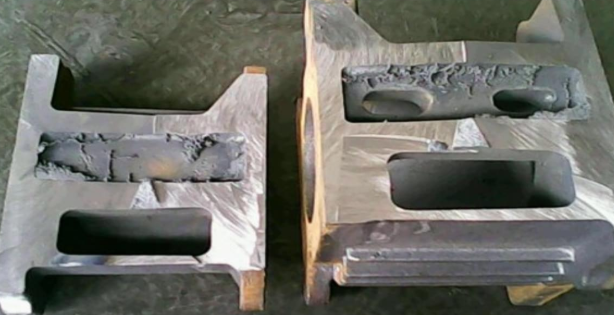
Coarse and concentrated sand grains form large gaps for molten metal penetration.
Insufficient coating thickness and poor heat resistance.
Low mold and core compactness.
High proportion of new sand weakens penetration resistance.
Over-aged molding sand and high sand temperature deteriorate surface stability.
Preventive Measures
Optimize sand grain gradation to narrow intergranular gaps.
Ensure coating Baume degree over 30. Apply double-layer coating on heavy hot sections. Add over 20% zircon powder to graphite coating for improved thermal shock resistance.
Improve compactness of molds and cores.
Increase proportion of reclaimed sand and avoid expired sand application.
3. Veining Defects
Causes
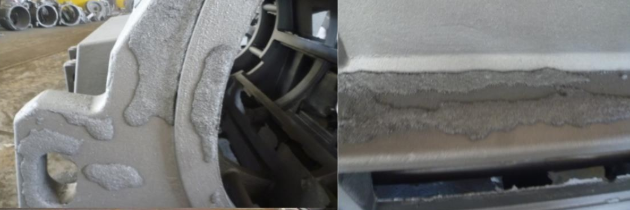
High thermal expansion coefficient of silica sand cracks coating layers under heating. Molten metal infiltrates cracks and forms vein marks usually accompanied by penetration defects.
Preventive Measures
Raise reclaimed sand proportion to reduce thermal expansion and match expansion rate between sand mold and coating.
4. Cracks
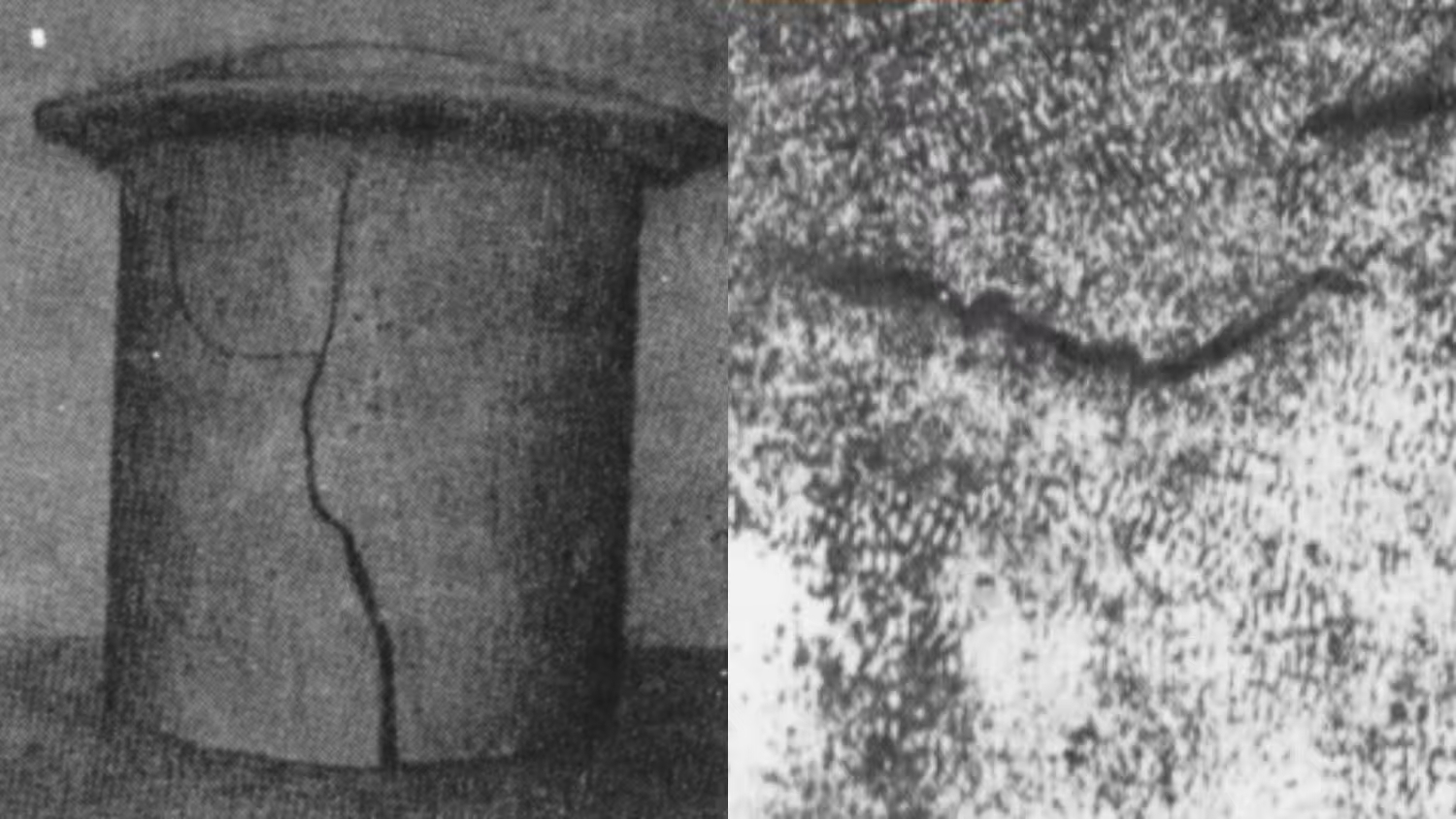
Furan resin sand molds have high rigidity and thermal expansion coefficient, resulting in slow cooling and higher hot cracking tendency, especially for steel castings. Sulfonic acid hardener causes sulfur permeation and surface microcracks. Cracks easily emerge on parts with complex structure, uneven wall thickness and large shrinkage resistance.
Preventive Measures
Add 2%-3% wood flour to improve mold collapsibility.
Reduce sand thickness, manufacture hollow cores and embed polystyrene blocks.
Replace silica sand with zircon sand or chromite sand at crack-prone areas.
Optimize gating system for simultaneous solidification.
Revise casting structure reasonably and set anti-crack ribs.
Reduce pouring temperature appropriately.
Adopt chill blocks for accelerated cooling.
Replace sulfonic hardener with phosphoric acid hardener under severe working conditions.
5. Slag Inclusion
Causes
Slag generates from reaction between molten metal and binder. High temperature burns mold tops and forms scabs, mostly appearing at upper cavity surfaces along with blowholes.
Preventive Measures
Adopt fast, stable, closed bottom gating with sufficient metallostatic head. Install overflow risers to discharge contaminated molten metal.
Apply high-strength, heat-resistant and low-gas-evolution coating.
Tilt pouring for large flat castings equipped with overflow risers.
6. Insufficient Hardness
Causes
Poor thermal conductivity of furan resin sand slows down solidification. Surface hardness within 3mm depth is 10-15 HB lower than internal hardness.
Preventive Measures
Lower carbon equivalent to restrain ferrite formation.
Add trace chromium and copper to stabilize pearlite structure.
Use chill blocks and tellurium coating to accelerate cooling.
Reduce pouring temperature and advance shakeout time properly.
Remove surface layer over 3mm before hardness testing.