



Veining Defect Rate Reduced from 10% to 0.8%: XINDA Anti-Veining Additive Helps Foundries Cut Costs Substantially
2026-08-03 15:48In resin sand casting, veining defects are a long-standing challenge for many casting manufacturers. Complex inner cavities and thin-wall components are prone to forming raised mesh-like veining, driving up scrap rates as well as costs for grinding and repair welding. A large automotive parts foundry achieved dramatic improvement in veining defects and a notable reduction in overall production costs after adopting the XINDA Anti-Veining Additive, offering a viable new solution for the industry to tackle veining issues.
Ⅰ. Existing Pain Points of the Enterprise: Persistent Difficulty in Eliminating Veining Defects
The foundry mainly produces engine parts, brake discs and other automotive components. It has long suffered from veining defects, and various conventional improvement solutions have obvious drawbacks:
Application of anti-veining coatings: Extra coating and drying procedures increase labor costs; uneven coating thickness makes it impossible to completely eliminate veining defects.
Conventional inorganic additives: Veining defects are alleviated slightly, yet new casting defects such as blowholes and sand adhesion tend to occur.
Resin ratio adjustment and pouring process optimization: Multiple rounds of process tuning achieved limited results. The veining scrap rate remained stable at approximately 10%, resulting in continuous high losses from scrap disposal, grinding and repair welding.
Ⅱ. New Solution: Application of XINDA Anti-Veining Additive
The light red powdered XINDA Anti-Veining Additive delivers a simple upgrade solution with no need to modify the basic production line process:
Feeding method: Add directly during sand mixing, no additional working procedures required;
Dosage: Only 0.5% of sand mass (applicable range: 0.3%~1.0%);
No need to replace resin, molds or pouring parameters, with low implementation barriers.
Ⅲ. Measured Effects after Mass Production
Remarkable optimization of multiple indicators after scaled-up application:
Defect control: Veining on castings are largely eliminated, with the veining defect rate dropping from 10% to below 0.8%;
Process optimization: Internal anti-veining coating is cancelled, and the surface finish of casting inner cavities is improved; grinding working hours reduced by 60%;
Economic benefit: Comprehensive production cost savings exceed 80,000 RMB per production line monthly.
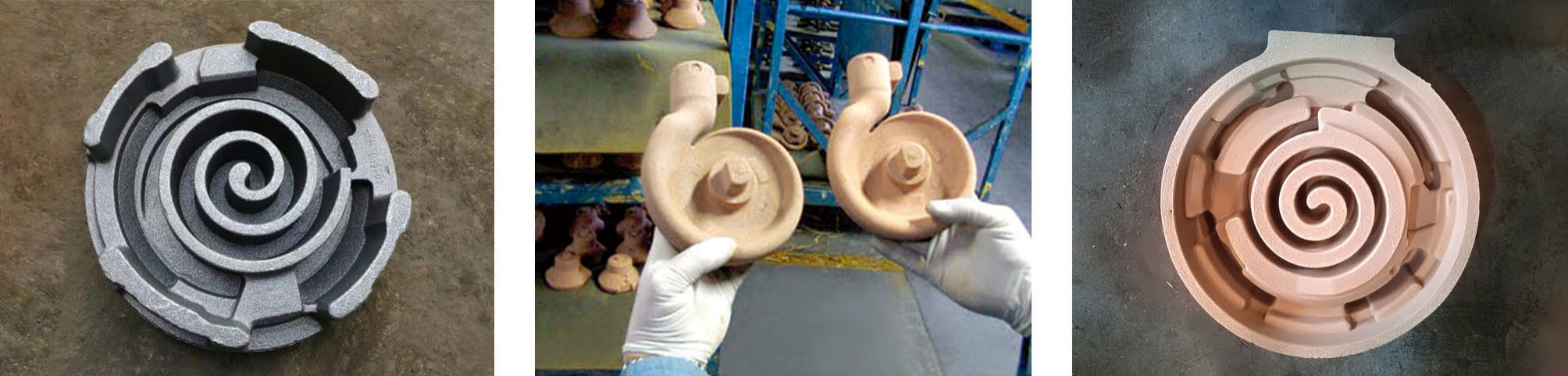
Ⅳ. Product Mechanism
When molten metal is poured at high temperature, sand cores expand thermally and develop surface cracks. Penetration of molten iron into cracks forms veining defects.
The XINDA Anti-Veining Additive provides dual protection:
Buffer thermal expansion deformation of sand cores and restrain surface cracking;
Form a protective layer on sand grains to block penetration of molten iron. The product features low gas evolution, effectively preventing secondary casting defects including blowholes and sand adhesion.
Ⅴ. Comparison of Core Advantages
| Comparison Item | Traditional Anti-Veining Solution | XINDA Anti-Veining Additive |
|---|---|---|
| Dosage | 10%-15% | 0.3%-1.0% |
| Operation | Coating & drying, high labor cost | Direct addition during sand mixing, no extra procedures |
| Effect | Minor veining reduction, easy to trigger blowholes & sand adhesion | Veining elimination rate above 98%, no secondary defects |
| Process Compatibility | Restrictive, incompatible with some processes | Fully compatible with cold-box, hot-box and no-bake resin sand |
| Overall Cost | High cost from labor, consumables and scrap | Save coating expenses, reduce grinding workload and scrap losses |
Ⅵ. Scope of Application
Casting material: Cast iron, cast steel
Product types: Automotive components, construction machinery parts, hydraulic components, pumps & valves, large castings, complex inner cavity and thin-wall castings
Molding processes: Cold-box resin sand, hot-box resin sand, no-bake resin sand
Profit margins in the casting industry are narrow, and casting defect rates directly determine corporate profitability. Veining defects remain a stubborn production problem troubling numerous foundries.
Without complicated process modification or costly production line upgrades, XINDA Anti-Veining Additive precisely addresses veining challenges in resin sand casting. With low dosage, low gas evolution, no secondary defects and full process compatibility, it efficiently cuts casting defect rates and reduces labor and consumable expenses.
By abandoning the drawbacks of traditional anti-veining solutions, manufacturers can adopt this high-efficiency cost-saving solution to realize quality improvement and cost reduction. The product has been stably applied in many large foundries with verified performance. Foundries plagued by veining defects are welcome to contact us for free sample testing and gain new advantages in casting production!