



Xinda Tackles Slag Blowhole Defects: Full-Set Technical Solutions to Reduce Casting Scrapping Losses
2026-06-11 09:37Xinda has carried out systematic technical research on slag blowholes, a typical metallurgical defect featuring high production loss and easy misjudgment in cast iron production. From four dimensions including defect morphology & distribution, metallurgical formation mechanism, accurate inspection & identification, and full-process prevention & control strategy, Xinda has established a complete integrated technical system. It provides implementable and standardized technical support for foundry enterprises worldwide to solve the critical pain point of mass casting scrapping.
I. Distribution and Morphological Characteristics of Slag Blowholes
Slag blowholes show obvious positional tendency. They mainly accumulate at the top filling surface of castings where floating slag gathers, and a large number also adhere to the lower surface of sand cores. The bottom of core 1 and core 2 shown in the figure are typical high-risk areas for this defect. Most defect cavities are spherical, while a small number are irregular. The inner wall of cavities is covered with gray to blue-gray composite slag film of sulfide and oxide, and some cavities contain free iron beads precipitated during solidification. The cavity sizes vary discretely, with the pore diameter generally ≤10 mm, distributed in dense clusters.
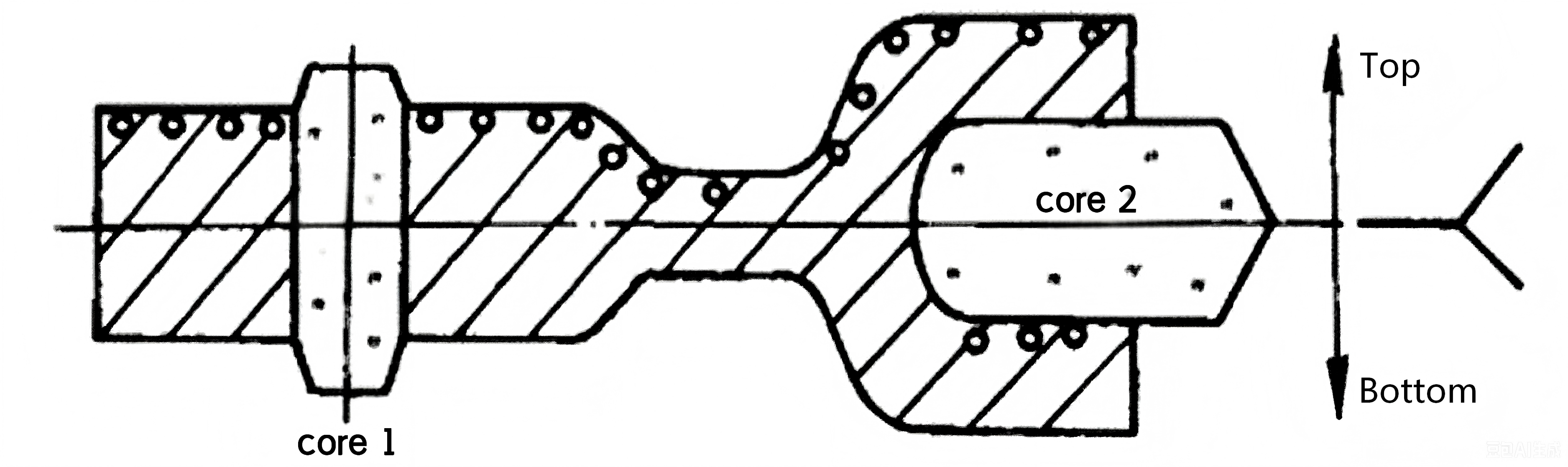
Defects will be fully exposed after rough machining of castings. Workpieces with slag blowholes are extremely difficult to repair and almost directly scrapped, resulting in severe production cost losses. The appearance of this defect is highly similar to invasive blowholes and sand inclusions. On-site technicians tend to misattribute the root causes to insufficient mold drying, molten iron oxidation and mold sand dropping, failing to implement targeted solutions for radical treatment. For production lines lacking impurity control of raw and auxiliary materials, low pouring temperature and extensive process management, the occurrence frequency of slag blowholes rises sharply.
II. Metallurgical Formation Mechanism of Slag Blowholes
Slag blowholes are composite defects formed by the coupling of slag inclusions and precipitated gas, driven by two consecutive metallurgical reactions:
Generation of low-melting liquid manganese sulfide slag
Sulfur exists as solid-dissolved FeS in molten iron, which undergoes exothermic displacement reaction with Mn in molten iron:FeS + Mn = Fe + MnS; The generated MnS is infinitely miscible with iron oxide-based oxidation slag, greatly reducing the liquidus temperature of slag and forming liquid composite slag with excellent fluidity. This displacement reaction is exothermic. Thermodynamic laws indicate that the lower the pouring temperature, the stronger the forward reaction trend, and the output of liquid slag rises exponentially. The higher the original S and Mn content of molten iron, the higher the enrichment degree of low-melting slag in the system, which significantly amplifies the pre-risk of defects.
Formation of cavities coexisting with slag and gas
After liquid slag entering the mold cavity with molten iron accumulates at the bottom of cores and the top surface of castings, FeO in slag phase reacts with carbon in molten iron matrix to produce gas via reduction reaction: FeO + C = Fe + CO↑; Continuous CO gas precipitates from the reaction, wrapped by high-viscosity liquid slag and unable to float up and escape. After casting solidification, slag blowholes coexisting with slag and gas are formed.
III. Hierarchical Accurate Identification Methods for Defects
To distinguish slag blowholes from conventional blowholes and slag inclusions, Xinda has established a triple linkage identification standard covering metallographic examination, chemical analysis and on-site process inspection:
Primary screening via metallographic structure identification
Metallographic specimens are prepared from defective areas. If continuously segregated and enriched MnS sulfide inclusions exist at cavity boundaries accompanied by dispersed fine oxide slag particles, the defect can be preliminarily identified as slag blowhole.
Precise identification via chemical composition analysis + sulfur print test
Spectral chemical detection is carried out on casting bodies. When w(S) in molten iron ranges from 0.12% to 0.14% and w(Mn) exceeds 0.6%~0.8%, sulfur print test is conducted on defect cross-sections. If obvious banded segregation traces of sulfide are detected, slag blowhole can be fully confirmed.
Auxiliary verification via process temperature
Mass industrial production data verifies that when stable pouring temperature reaches ≥1300℃, the generation of low-melting MnS slag in the system is significantly inhibited, and the occurrence rate of slag blowholes drops substantially.
IV. Collaborative Full-Process Technical Measures for Defect Prevention & Control
Based on the complete metallurgical formation mechanism of slag blowholes and combined with practical experience of large-scale on-site production, an integrated prevention & control system covering melting, transportation, pouring and ingredient ratio control is constructed:
Precise temperature field control of molten iron
Adopt high-temperature pouring process with the minimum final pouring temperature ≥1300℃. If sulfur content of raw molten iron exceeds standard, the pouring temperature can be increased by 30~50℃ accordingly to inhibit manganese sulfide generation from a thermodynamic perspective. Shorten the molten iron transportation process and strictly control the holding time of molten iron in ladles. Ladles must be completely emptied after use. It is forbidden to pour high-temperature new molten iron into ladles with residual low-temperature molten iron and slag, so as to avoid local low temperature triggering sulfuration reaction.
Upgrading slag skimming and slag blocking system for ladles
Prioritize the use of teapot-type slag separating ladles to realize pre-settlement and separation of furnace slag via structural design. Slag forming agents shall be added for slag gathering and thorough manual slag skimming before each ladle pouring. Slag stoppers and slag weirs shall be equipped throughout the pouring process to intercept floating slag. Ladles shall be fully cleaned after intermittent use to avoid residual mixture of low-temperature slag and molten iron.
Structural optimization of gating system for slag interception
Reconstruct horizontal runners and ingates by adding multi-stage slag intercepting structures such as slag traps, ceramic filters and slag baffles. Liquid MnS composite slag is intercepted at the source of mold filling to prevent slag from floating up, attaching to core bottom and continuously generating gas.
Precise ingredient ratio control for sulfur-manganese balance
Follow the sulfur-manganese neutralization balance formula Mn=1.7S+0.3% to ensure sufficient manganese to neutralize free ferrous sulfide. During ingredient design, select the lower limit of standard values for S and Mn content to avoid excessive elements aggravating slag generation. If raw materials have excessive sulfur content, do not adopt single manganese increment to neutralize sulfur; priority shall be given to raising pouring temperature for defect control.