



Casting Burn-on Defect: Identification, Causes and Prevention
2026-09-19 12:29I. What is burn-on
Burn-on is one of the most common casting defects. It is generally divided into mechanical burn-on and chemical burn-on. In practice, burn-on is often the combined result of mechanical and chemical burn-on.
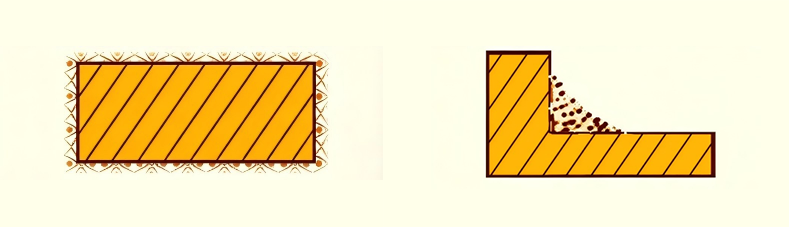
Mechanical burn-on. Also known as metal penetration burn-on. It occurs when molten metal or metal oxides penetrate into the gaps between sand grains of the mold through capillary action or gas-phase penetration, forming an adhered layer of mechanically mixed metal and sand grains on the casting surface. Metallic luster can be observed when chipping off the burn-on layer. Mechanical burn-on features a sponge-like surface firmly bonded to the casting. It mostly appears in areas subject to intense thermal loading and low mold compactness, such as near gates and risers, heavy sections, inner corners and grooves of castings.
Chemical burn-on. A layer of low-melting-point compounds formed by the interaction of metal oxides, sand and clay adheres to part or the entire casting surface. The burn-on layer has high hardness and strong bonding with the casting surface. It cannot be removed by shot blasting or grit blasting and must be ground off with abrasive wheels. Chemical burn-on normally occurs at heavy sections and overheated areas of molds and cores.
Thermal burn-on. A thin layer of sintered glassy mold sand adheres to the casting surface, frequently found in heavily heated regions of the mold. No metal penetrates into the burn-on layer, which is easy to clean.
Surface roughness. Mild penetration of molten metal into gaps between surface sand grains, representing the early stage of mechanical burn-on. It is characterized by rough casting surface. The depth of the rough layer is roughly equal to the sand grain size, while the surface metal of the casting is not fused with sand grains. It commonly occurs on the cope surface of green sand molds and areas without coating or with too thin coating in dry sand molds, often accompanied by sand inclusions, rat tails and scabs.
II. How to identify burn-on
Visual inspection is adopted for on-site examination. It is relatively easy to distinguish burn-on from other defects, while differentiating various types of burn-on is difficult, especially chemical burn-on and mechanical burn-on. They look similar, share most root causes, serve as mutual prerequisites and promote each other, and both show metallic luster during cleaning. Generally speaking, thermal burn-on contains no metal, often appears glassy and thin, mostly occurs in clay-bonded sand molds and can be cleaned easily. Surface roughness usually carries no sand grains or only slight local burn-on. Chemical burn-on is common in clay sand or water glass sand and extremely hard to remove, requiring abrasive wheel grinding. Mechanical burn-on can occur in all types of sand molds, presents sponge-like appearance, and can be cleaned by shot or grit blasting, though grinding is sometimes needed. Burn-on in resin-bonded sand molds is usually mechanical burn-on.
III. Formation mechanism of burn-on
Too coarse grain size of molding and core sand.
Low or uneven compactness of molds and cores.
Poor coating quality, uneven coating thickness or coating peeling on molds and cores.
Excessively high pouring temperature and pouring height, leading to high dynamic pressure of molten metal.
Overheight of the cope or pouring basin, resulting in high static pressure of molten metal.
Excessive clay, binder or fusible additives in molding and core sand, causing low refractoriness and poor thermal conductivity.
High proportion of reclaimed sand in molding and core sand. Reclaimed sand contains excessive fine particles, dust, dead-burned clay and metal-coated sand, lowering the sintering temperature of molding sand.
Delayed shakeout after casting, resulting in solid-state thermal burn-on, especially for heavy-section castings and high-melting alloy castings.
Molten metal with good fluidity and low surface tension. For instance, excessive phosphorus and lead in copper alloys, or excessive phosphorus, silicon and manganese in cast steel.
Molds and cores made of resin sand without coating, poor coating quality or uneven coating thickness. During pouring, resin films between sand grains gasify and form capillary channels. Under the combined effect of static pressure, vapor pressure and surface tension, molten metal or metal vapor penetrates into capillary channels and forms mechanical burn-on.
Oxides and low-melting compounds in molten metal react with molding sand to form low-melting substances such as fayalite, which reduce surface tension and improve fluidity of molten metal. Through capillary mechanism, these low-melting compounds and molten metal infiltrate sand gaps, continuously erode sand grains, widen intergranular gaps and trigger mechanical or chemical burn-on.
Improper design of gating system and risers, causing local overheating of molds and castings.
Some casting alloys with high manganese or chromium content tend to form basic oxides. These oxides react with acidic silica sand and produce chemical burn-on.
IV. Effective prevention of burn-on
Use fine base sand with high refractoriness.
When applying reclaimed sand, remove ultra-fine grains, dead-burned clay, ash, metal oxides, scrap metal, metal-coated sand and other harmful impurities to improve reclaimed sand quality. Add an appropriate amount of new sand regularly.
Water acts as a strong oxidant. Strictly control moisture of green clay sand, and add carbonaceous materials such as coal dust, asphalt and hydrocarbons to form a reducing atmosphere inside the mold. Reduce carbonaceous materials for high-pressure molding to cut gas generation.
Adopt high-quality bentonite and lower clay content in clay sand.
Maintain proper binder content in molding sand, avoid excessive dosage. Improve sand mixing quality to ensure sand grains are evenly covered by binder film with proper permeability and prevent agglomerates in molding sand.
Raise the compactness and compactness uniformity of sand molds.
Design gating system and risers to avoid local overheating of castings and molds. Prevent ingates from directly impacting mold walls.
Apply anti-burn-on coating with uniform thickness. Increase coating thickness appropriately on areas prone to burn-on. The coating shall contain no gas-generating, oxidizing components or substances reactive with molten metal and molding sand. Avoid using coatings or facing sand that form peelable glassy burn-on layers at the metal-mold interface via chemical reaction (e.g. adding hematite powder into molding and core sand for iron castings).
Moderately reduce pouring temperature, pouring speed and pouring height, and lower cope and pouring basin height to decrease dynamic pressure, static pressure and thermal shock exerted by molten metal on molds.
Strengthen refining for high-melting alloys such as cast steel. Purify molten metal, reduce oxidation and gas absorption, limit elements forming low-melting phases (S and P in cast steel and cast iron, P and Pb in bronze), and control elements lowering surface tension and raising vapor pressure of molten metal (Mn and Si in cast steel and cast iron, Pb in bronze). Keep furnace charge dry during melting, cautiously use fluxes that cause chemical burn-on (limestone, sodium carbonate powder, fluorite etc.), and avoid excessive melting temperature to prevent over-oxidation of molten metal.
For large heavy-wall castings, shake out moderately earlier to accelerate cooling and prevent solid-state burn-on.
Use patterns and core boxes with smooth surface finish.
Apply special sands such as chromite sand, zircon sand and artificial spherical sand.
Burn-on defects are caused by a combination of penetration, thermal effect and chemical reaction between molten metal and molding materials. Different burn-on types have distinct formation rules. Strict control of raw sand quality, coating application, mold compactness and pouring parameters can effectively mitigate burn-on and improve the surface quality of finished castings.