



Solving Slag‑Inclusion Problems of Large‑tonnage Wind‑power Castings with Foam Ceramic Filters
2026-08-27 08:58Wind‑power equipment castings are key heavy‑load components operating under complex service conditions, which impose extremely high requirements on internal cleanliness and compactness of castings. Large‑tonnage ductile iron wind‑power castings feature large molten‑iron weight and long pouring time. In the filling process, oxidation slag, entrained slag and other inclusions are easily generated, triggering internal inclusions and gas porosity defects. These problems directly reduce the qualification rate of flaw detection and bring high risks of rework and rejection.
Conventional filtering solutions suffer from multiple pain points: large‑quantity filter consumption, limited layout space inside the sand box, high risk of filter blockage by molten slag, and secondary oxidation slag formed during mould filling. In this production, the annular foam ceramic filter is adopted for verification on large‑tonnage ductile iron casting conditions. It realizes efficient slag retention and filtration, optimizes sand box layout, cuts filter consumption, improves filling status, upgrades casting quality and reduces comprehensive foundry costs.
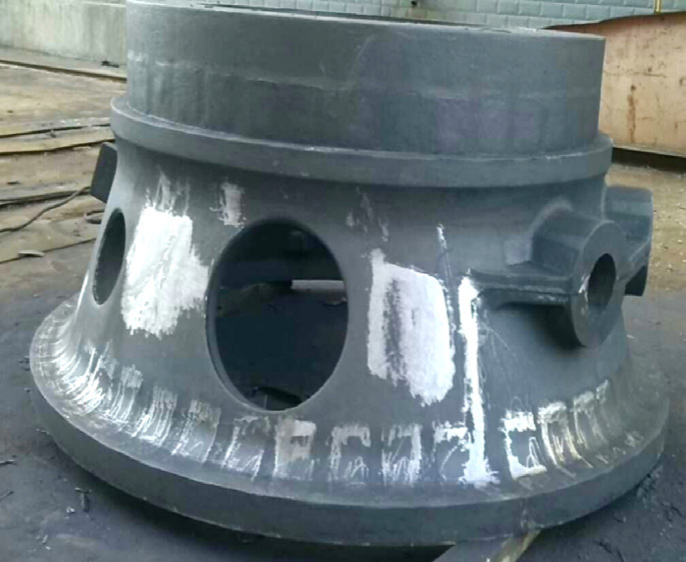
Ⅰ、 Casting and Process Parameters
| Casting Name | Material | Weight of filtered molten iron per unit | Pouring Temperature | Pouring Time |
| Wind‑power Part | Ductile Iron | 9000 kg | 1360℃ | 150 s |
Ⅱ、Core Advantages of Annular Foam Ceramic Filter
Greatly reduced filter consumption and saved sand‑box space
The annular structure delivers large filtration area with small occupation inside sand boxes. It facilitates layout within limited mould cavity and solves the problem of crowded arrangement of multiple filters for large castings.
High loading capacity and reliable service safety
Molten metal flows from outside to inside, making full use of both inner and outer surface areas of the filter. It can bear large‑flow molten metal, adapt to pouring conditions of heavy‑weight castings and lower the risk of filter cracking.
Excellent anti‑clogging performance for stable continuous filtration
The filter is vertically installed, providing sufficient floating space for molten slag. Slag hardly accumulates to block filter channels, maintaining stable filtration performance for long‑duration pouring.
Optimized sand consumption for cost‑effective production
It can be pre‑buried at proper pouring positions according to sand‑box structure and cavity layout, optimizing sand consumption and reducing mould‑sand material input.
Restrain secondary oxidation slag for stable mould filling
Molten iron flows out from the top hole of filter unit and then enters the mould cavity steadily. It slows down molten‑iron flow velocity, mitigates turbulence‑caused gas and slag entrapment, inhibits secondary oxidation slag and improves filling conditions.
Ⅲ、On‑site Application and Result Analysis
In actual production, the annular foam ceramic filter exhibits outstanding adaptability for large‑flow filtration. Slag and inclusions are effectively trapped on the filter surface and prevented from entering the casting cavity.
Improved operational safety: Molten iron avoids direct impact on filter body. The risk of filter damage caused by molten‑iron erosion is eliminated, and the overall loading capacity is significantly enhanced for reliable performance under high‑flow pouring.
Remarkable anti‑clogging effect: Molten‑iron slag tends to float upwards and separate, lowering the probability of filter hole blockage and maintaining stable filtration effect throughout pouring.
Superior pouring‑pressure resistance: Benefiting from mechanical merits of annular structure, the filter can withstand pouring pressure brought by large‑tonnage molten iron as metal flows inward from outer side.
Large filtration flow rate and lower material consumption: Thanks to high flow capacity, a single unit greatly cuts down the quantity of required filters compared with traditional solutions and reduces material costs.
Flexible layout for lower comprehensive costs: Installation position can be adjusted flexibly based on inner sand‑box space. It optimizes sand‑to‑metal ratio, lowers consumption of mould sand and filters, and achieves dual improvement in casting quality and production cost.
Post‑production inspection verifies that slag‑related casting defects are well controlled. The internal quality of castings is improved and meets flaw‑detection and quality acceptance requirements for wind‑power castings.
Xinda annular foam ceramic filter is specially optimized for heavy‑tonnage complex castings in wind‑power, heavy‑machinery, pump‑valve industries, compatible with ductile iron and steel castings. With large filtration flow rate, high impact resistance and anti‑clogging performance, it supports diversified pre‑buried layout solutions in sand boxes, helping foundries reduce inclusion defects and casting rejection rate to realize quality improvement and cost reduction.
Besides full series of foam ceramic filters including Silicon Carbide Foam Ceramic Filter, Zirconia Foam Ceramic Filter, Alumina Foam Ceramic Filter, Xinda provides complete foundry‑material portfolio: Alcohol‑based Coating, 3D Printing Resin and Supporting Materials, Furan Resin And Supporting Curing Agent, Cold Box Resin, Alkaline Phenolic Resin And Supporting Curing Agent, Anti‑veining Additive. The product matrix covers molten‑metal filters, casting coatings, sand‑mold binders and foundry auxiliary materials. Suitable for resin‑bonded sand, cold‑box core‑making and sand‑mold 3D‑printing processes, Xinda delivers one‑stop material and technical solutions for wind‑power, heavy‑machinery, pump‑valve, automotive and aerospace sectors.