



Strict Sealing Control to Avoid Pouring Defects — Xinda Mould Sealing Strip Performance Test Results Released
2026-10-28 09:00In casting production, metal run-out and casting flash are typical quality problems that have long troubled manufacturers. Recently, Xinda has completed a full set of pilot comparison tests for mould sealing strips. The differentiated advantages of the product have been verified from multiple dimensions including formulation, internal control indicators, high-temperature pouring stability, moisture resistance and unit use cost, providing a reliable mould-joint sealing solution for cast iron, cast steel and non-ferrous alloy castings.
Ⅰ. Product Formulation and Application Scope
Xinda mould sealing strip is compounded from oils, clays and mineral fiber raw materials. It features excellent plasticity and uniform strip diameter. When used for mould assembling, it ensures even pressure on the top and bottom mould halves with reliable sealing performance. It effectively restrains casting flash and metal run-out, improves dimensional accuracy of castings, and is easy to operate to save working hours on site.
Suitable for cast iron, cast steel and non-ferrous alloy castings, the product is compatible with mainstream sand mould processes such as clay sand, water glass sand and resin sand with great versatility.
Ⅱ. Strict Internal Process Indicators for Stable and Controllable Factory Quality
Xinda has established refined quality control standards for mould sealing strips, with clear test specifications for appearance, plasticity, dimensional tolerance and strength:
Appearance: Non-sticky, non-hardening and uniform thickness of strips.
Plasticity Index: Upper limits are set according to different diameter specifications. Target ranges are divided by seasonal temperature changes to guarantee stable handling performance in winter and summer.
Diameter Tolerance: ±0.5 mm for Φ3~Φ10; ±0.7 mm for Φ12 and above.
Tensile Strength: When hung at a height of 1 meter, the strip shall not break within 30 seconds right after production. After 24 hours of storage at ambient temperature, it shall not break within 150 seconds, meeting strength requirements during transportation, storage and mould assembling.
Ⅲ. High-Temperature Pouring Comparison Test: Structural Integrity Under High-Temperature Conditions
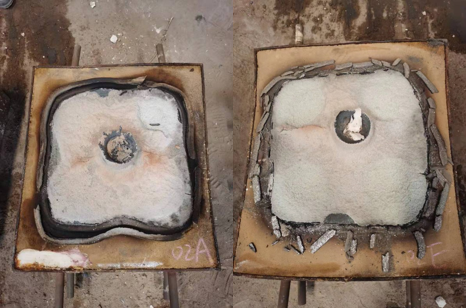
A comparative pouring test under identical conditions was carried out at our pilot base to directly compare the high-temperature resistance of Xinda mould sealing strip and low-cost alternatives on the market.
After pouring, Xinda mould sealing strip remains intact and maintains stable sealing on the mould joint surface. By contrast, low-cost competitors quickly disintegrate and pulverize under heat and lose structural strength, which may easily cause metal run-out. The outstanding thermal stability of Xinda mould sealing strip ensures reliable sealing throughout pouring and reduces the risk of casting rejection.
Ⅳ. Water and Moisture Resistance Test: Adaptable to High-Humidity Storage in Foundry Workshops
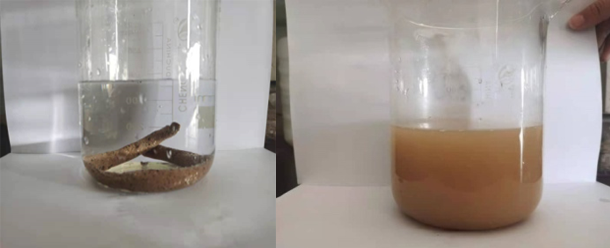
Failure after storage in humid conditions is a common drawback of many mould sealing strips. In the immersion test, low-cost competitors show powder shedding and dissolution after one hour of soaking, leading to sharp strength loss during long-term storage in humid workshops. Xinda mould sealing strip retains stable structure after soaking with superior water and moisture resistance. It reduces loss caused by dampness and adapts to complex storage environments in foundries.
Ⅴ. Unit Weight Test: Double Usable Length at the Same Weight to Optimize Overall Application Cost
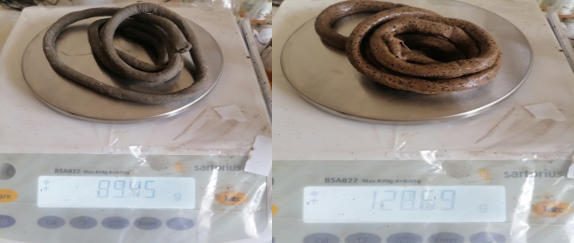
For samples with identical diameter and length, Xinda mould sealing strip weighs much less than competing products. With the same purchase weight, the usable length of Xinda product is nearly doubled.
This feature breaks the stereotype that high-performance casting consumables are expensive. Although the price per kilogram may differ, Xinda mould sealing strip is highly competitive when calculated by sealing cost per meter, balancing premium quality and production cost for customers.
As a special sealing consumable for mould assembling in casting, mould sealing strip, though easy to overlook, directly affects casting yield and pouring safety. With optimized formulation and full-process quality control, Xinda mould sealing strip delivers comprehensive advantages in plasticity, high-temperature stability, moisture resistance and cost-effectiveness. It helps foundries reduce rejects caused by metal run-out and flash, cut auxiliary material consumption and simplify on-site operations.
Xinda will keep focusing on the R&D of casting supporting materials, launching more high-performance products suitable for resin sand, water glass sand and other processes, and providing stable, cost-effective material solutions for the casting industry.