



What Are the Core Requirements for Riser Sleeves to Avoid Casting Shrinkage Defects?
2026-03-27 09:43Core function: Feeding castings to prevent shrinkage cavities in castings;
Auxiliary functions: First, exhaust gas—during pouring, a large amount of gas in the mold cavity can be smoothly discharged out of the mold through the riser sleeves; second, slag collection—since riser sleeves are usually located at the top of castings, slag will float up and accumulate in the riser sleeves; third, serving as an intuitive indicator that the mold cavity is filled with molten metal.
II. Basic Requirements for Riser Sleeves to Achieve Effective Feeding
Spatial requirement: Riser sleeves must be within the effective feeding distance of the casting to ensure that molten metal can reach the parts requiring feeding;
Solidification time requirement: The modulus of the riser sleeve must be greater than that of the casting, that is, the solidification time of the riser sleeve must be longer than that of the casting, ensuring that the riser sleeve remains in a liquid state during the solidification process of the casting and continuously provides molten metal for feeding;
Molten metal volume requirement: The riser sleeve must store a sufficient amount of molten metal to meet the shrinkage needs of the casting during the liquid and solidification processes;
Channel requirement: The feeding channel between the riser sleeve and the casting must remain unobstructed during solidification to ensure that molten metal can smoothly flow to the shrinkage part of the casting.
III. Principles for Determining the Position of Riser Sleeves
Follow the principle of directional solidification, and place the riser sleeve as close as possible to the upper part of the casting that needs feeding or the hot spot that solidifies last;
Prioritize placing it at the highest and thickest part of the casting, using the gravity of the molten metal column in the riser sleeve to enhance the feeding effect;
If there are multiple hot spots at different heights of the casting that need feeding, riser sleeves can be set separately. At the same time, chillers should be used to separate the feeding areas of each riser sleeve to avoid high-position riser sleeves feeding low-position riser sleeves at the same time, which would cause shrinkage cavities or shrinkage porosity in high-position castings;
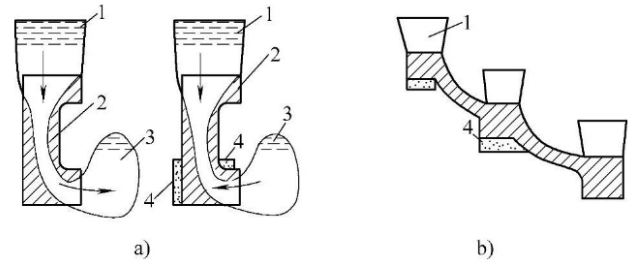
Avoid stress concentration points and crack-prone parts of the casting to prevent aggravating stress concentration and causing cracks in the casting;
Improve feeding efficiency and template utilization, and try to use one riser sleeve to feed multiple hot spots on the casting at the same time;
Place it close to the inner gate, or let the molten metal enter the riser sleeve through the inner gate to enhance the directional solidification of the casting and improve feeding efficiency;
Prioritize placing it on the machined surface of the casting to reduce subsequent finishing man-hours.
IV. Methods to Ensure That the Solidification Time of Riser Sleeves Is Longer Than That of Castings
Select riser sleeve shapes with slow heat dissipation, such as spherical and cylindrical shapes, to reduce heat loss;
Strictly control the modulus ratio to ensure that the moduli of the riser sleeve and the riser neck are both greater than that of the casting. Taking steel castings as an example, the modulus ratio must meet: Riser Sleeve : Riser Neck : Casting = 1.2 : 1.1 : 1.
V. Relationship Between Riser Sleeve Modulus and Feeding Molten Metal Volume
Check the size of the riser sleeve using the casting process yield;
Check the size of the riser sleeve by calculating the required amount of feeding molten metal.
VI. Influence of Feeding Channel on the Function of Riser Sleeves
Xinda Riser Sleeves accurately meet the core requirements of riser sleeve feeding, with excellent thermal insulation performance and precise modulus control. They can effectively extend the solidification time, ensure the feeding channel is unobstructed, greatly reduce the rate of casting defects such as shrinkage cavities and shrinkage porosity, and improve the internal quality and process yield of castings.Xinda Riser Sleeves are suitable for the production of steel castings, iron castings and various non-ferrous alloy castings, balancing feeding efficiency and cost control, reducing metal loss and finishing man-hours. With professional quality, they escort casting production and help enterprises reduce costs, increase efficiency, improve quality and upgrade.