



Xinda AT‑100D Alcohol‑Based Casting Coating Effectively Solves Inner‑Surface Burning‑On Defects of Duplex‑Steel Impeller
2026-08-20 09:21Liaoning Xinda Foundry Technology Co., Ltd. developed Xinda AT-100D alcohol-based casting coating, which has already passed application testing in the manufacturing of double-deck closed impellers in a foundry. With the purpose of overcoming external and internal burning issues from very high-temperature pouring and considerable wall-thickness variation in CA6NM duplex steel, the coating creates an even protective layer through double-pass brushing. The defects in the inner cavity caused by surface layer burning are completely removed after sand blasting, and the cleaning after work is greatly reduced.
Ⅰ. Product Introduction of Alcohol‑Based Coating
AT‑100D alcohol‑based casting coating is a white‑paste coating designed for small‑to‑medium‑sized cast steel parts. Using alcohol as carrier solvent, it features self‑drying by ignition and shortens core drying cycle.
| Appearance | Suspension | Density | Baume Degree Be° |
|---|---|---|---|
| White paste | ≥98% | 1.8‑2.1 g/ml | ≥120 |
With excellent suspension, thixotropy and leveling performance, the coating delivers uniform film thickness after brushing and avoids coating accumulation and sagging. It is suitable for small‑to‑medium‑sized castings of stainless steel and carbon steel, and compatible with multiple molding systems including water‑glass sand, alkaline phenolic resin sand and phenolic‑urethane binder.
Ⅱ. Case Background: Burning‑On Defects of Duplex‑Steel Impeller
The validated casting is a double‑deck closed impeller made of CA6NM duplex steel. Process parameters are listed below:
| Material | Pouring Weight | Finished Casting Weight | Pouring Temperature | Pouring Time | Minimum Wall Thickness | Maximum Wall Thickness | Melting Equipment | Mold Type | Core Type |
|---|---|---|---|---|---|---|---|---|---|
| CA6NM | 130 kg | 90 kg | 1610 ℃ | 20‑25 s | 5 mm | 35 mm | Medium‑frequency Induction Furnace | Alkaline Phenolic Resin Sand | Coated Ceramsite Sand |
This impeller has sharp wall‑thickness difference ranging from 5 mm to 35 mm. Under pouring temperature up to 1610 ℃, high‑temperature molten steel brings severe erosion to molds and cores. In original production, external and inner‑cavity burning‑on occurred frequently. Inner‑cavity burning‑on was difficult and time‑consuming to clean, which became a major bottleneck restricting production efficiency.
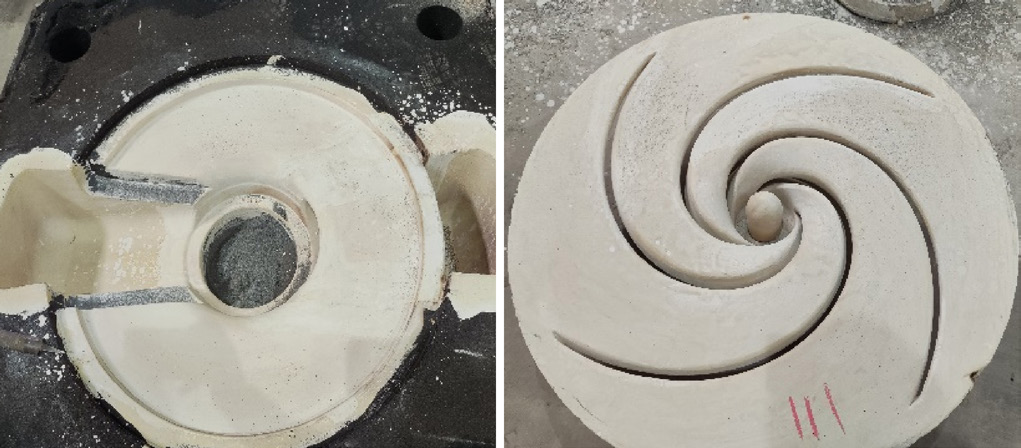
Ⅲ. On‑Site Application Process
According to casting structure and material characteristics, two‑pass brushing was adopted.
| Procedure | Baume Degree | Remarks |
|---|---|---|
| 1st Brushing | 65 Be° | Primer layer for adhesion and basic thickness |
| 2nd Brushing | 60 Be° | Topcoat for surface smoothness and compactness |
Coating Performance:
‑ Total coating thickness: 0.25‑0.35 mm
‑ High surface strength
‑ Smooth surface, free of cracks and brush marks
Gradient Baume‑degree control with two‑pass brushing ensures full coverage on cores, and prevents cracking and accumulation caused by excessive single‑pass thickness.
Ⅳ. Field Application Results
Good Process Compatibility
For cast‑steel impellers with large wall‑thickness variation, uniform coating was obtained after core drying without accumulation or sagging. It matches composite molding system of alkaline phenolic resin sand mold and coated ceramsite sand core.
Superior High‑temperature Erosion Resistance
The protective coating isolates 1610 ℃ molten steel from direct contact with molds and cores. No obvious burning‑on was observed on outer surfaces after pouring and cooling.
Inner‑cavity Burning‑On Defect Eliminated
After shot blasting, inner‑cavity burning‑on defects were effectively solved and inner‑surface quality was greatly improved.
Reduced Post‑processing Cost
Cleaning workload for inner‑cavity burning‑on is largely cut down, grinding labor hours are reduced and casting delivery cycle is shortened.
The problems of high-level pouring temperature and very different wall thickness are the usual causes of surface-layer burning on impellers made of CA6NM duplex steel. Using AT-100D alcohol-based casting coating together with strictly two-pass brushing and varying baume-degree control, protective coatings are very dense, strong and well-distributed. It protects against very high-temperatures of molten steel and reduces both external and internal burning defects by an overall improvement in their surfaces.
This example shows the effectiveness of AT-100D alcohol-based coating on small-to-medium steel castings especially stainless steel and duplex parts with high pouring temperatures. This is a model solution that can be repeated for similar castings' surface-quality control.
Liaoning Xinda Foundry Technology Co., Ltd. produces and researches casting materials. Our product list includes furan resin, phenolic resin (alkaline type), various alcoholic coatings, water-based coatings, ceramic foam filters, 3D-printing-compatible resins, anti-segregation agents, and heat risers among other items. We supply the casting industry with high-quality ingredients and complete process technologies worldwide.