



Xinda Exothermic Insulating Riser Sleeves for Automotive Castings
2026-11-11 09:10Exothermic insulating riser sleeves extend the solidification time of molten metal inside the sleeve through combined exothermic reaction and heat retention, improving feeding efficiency. They are suitable for high-volume automated production of ductile and grey iron automotive castings, resolving common drawbacks of conventional sand risers such as low yield, metal run-out and high fettling costs. Shrinkage cavities and porosity remain persistent challenges in casting production, driving up scrap rates and increasing labour and rework costs. Proper riser sleeve selection enables continuous feeding and balances the thermal field during solidification, minimizing defects from the source. We supply a full range of insulating and exothermic riser sleeves compatible with ductile iron, cast steel, alloy steel and other materials, for large castings, thin-wall parts and complex components. Easy to install with reliable feeding performance, our riser sleeves help foundries stabilize quality and reduce raw material consumption.
I. Four Core Advantages for Automotive Castings
Higher feeding efficiency and lower cost for improved yield: Outperforming ordinary sand risers significantly, these riser sleeves allow smaller dimensions, saving molten iron, cutting material loss and raising casting yield.
Strong process tolerance and consistent mass quality: Tolerates fluctuations in molten iron temperature and composition, mitigating the impact of melting variations on shrinkage defects and meeting strict mass quality control standards for automotive components.
Reduced workload for post-processing: The contact area of the riser sleeve neck is greatly reduced, lowering cutting, grinding and fettling work, as well as working hours and consumable expenses.
Expanded capacity for automated lines: More castings can be arranged on one pattern plate without additional capital equipment, boosting output per mould. Compatible with mainstream automatic moulding lines including DISA, FBO and FCMX.
II. Five Standard Application Methods on Automatic Moulding Lines (with applicable equipment and scenarios)
| Application Type | Operation Instructions | Applicable Lines / Products |
|---|---|---|
| 1: Direct mounting on pattern plate | Fixed onto the pattern plate with locating pins | High exothermic riser sleeves for high-pressure moulding lines, automotive housings |
| 2: Assembled with cores and placed in drag | Pre-assembled with sand cores and set into the drag | FCMX, DISA horizontal lines, complex cored castings such as brake calipers |
| 3: Press-fit into the cope | Force-fitted into pre-formed cavities of the cope | FBO/AMF, ACE/KW flask-turnover moulding lines |
| 4: Clearance fit with locating seat in drag | Custom locating stops machined on the drag for loose placement | All horizontal parting moulding lines, standard square riser sleeves |
| 5: Press-fit via core box on vertical moulding lines | Locked by core box tooling together with the mould | Vertical parting moulding lines, mass production of small parts such as brake calipers |
Ⅲ. On-site Processes and Practical Cases
Direct mounting on pattern plate
High exothermic riser sleeves are positioned and fixed on the pattern plate. The sleeve is embedded during moulding, eliminating separate core assembly, ideal for relatively simple automotive castings.
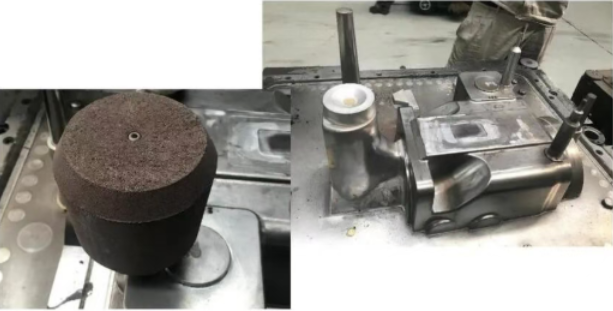
FCMX core assembly method
Riser sleeves are pre-assembled with core clusters and placed into the mould, suited for complex automotive brake parts with multiple cores and avoiding interference during mould placement.
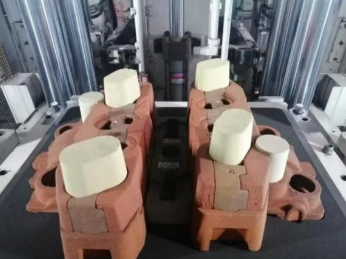
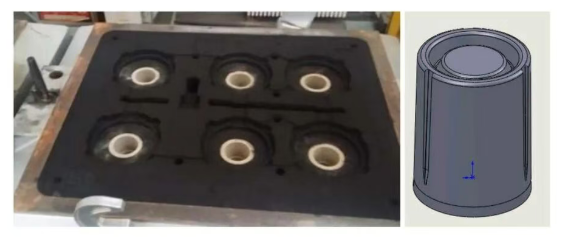
FBO press-fit into cope process
Designed for high-pressure flask-turnover moulding machines. The interference fit keeps riser sleeves intact and secured during compaction.
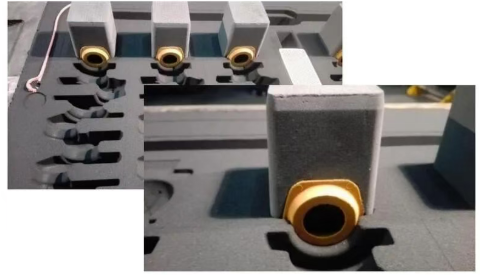
Locating seat clearance fit in drag
Positioned by mechanical stops for easy assembly and maintenance. Ideal for bulk use of standard square riser sleeves and reduces fixture commissioning effort.
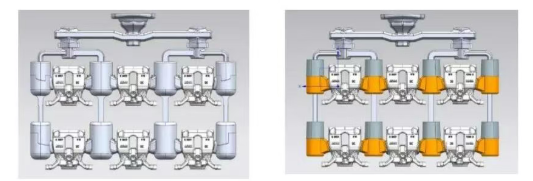
Field case: QT550 brake caliper on vertical moulding line
Original sand riser scheme: total mould weight 60 kg, single rough casting 2.9 kg, yield 29%, only 20 mm sand thickness on outer side, frequent flash-through and run-out during pouring.
After switching to exothermic riser sleeves: shared sleeve reduced from Φ80 mm to Φ60 mm, saving 12.3 kg molten iron per mould, yield increased to 36.9%. Larger sand thickness eliminates run-out completely while removing porosity defects.
Backed by mature formulations and stable production control, Xinda riser sleeves balance feeding performance and cost-effectiveness. Custom solutions are available based on your casting drawings to continuously reduce scrap and raise efficiency for your foundry.