



How Are Foamed Ceramic Filters Applied in Aluminum Alloy Production?
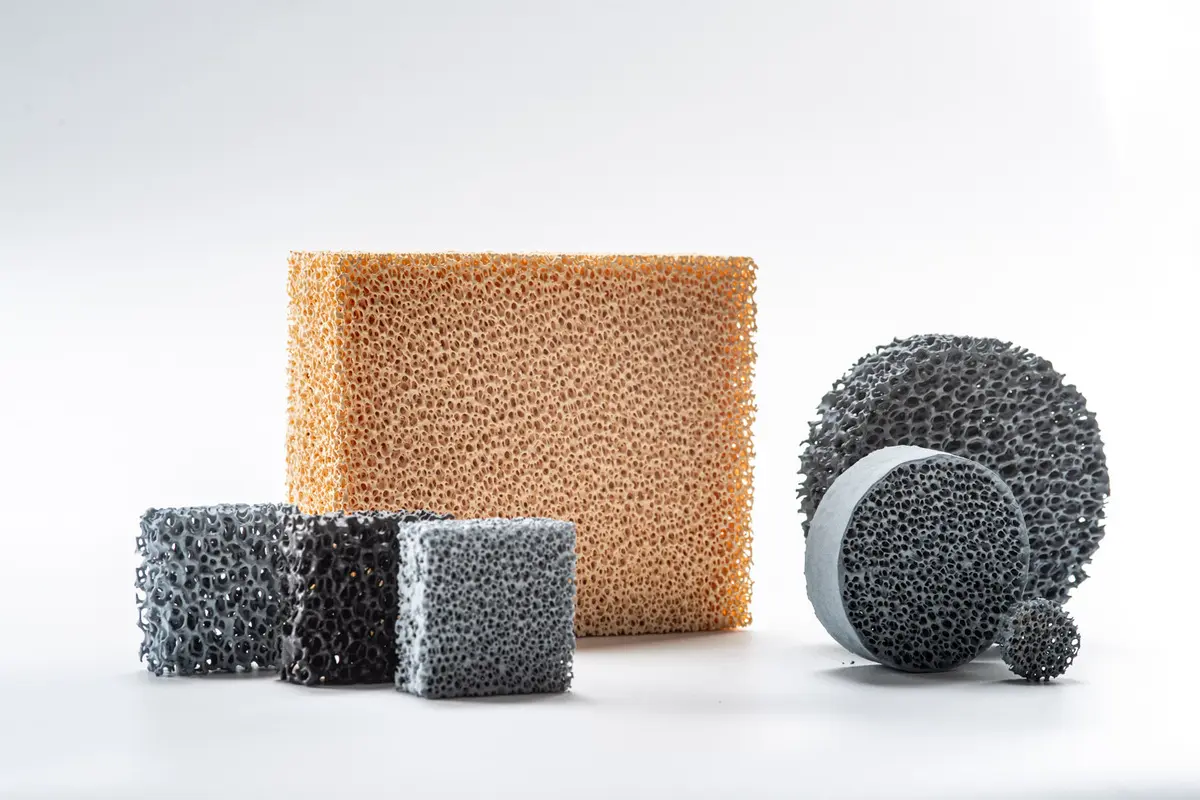
2026-03-19 13:37Foamed ceramic filters possess a unique three-dimensional interconnected curved mesh skeleton structure with a porosity of 80%~90% and a filtration efficiency of up to 90%. This significantly reduces casting scrap and weld repair rates, simplifies the gating system, improves metallographic structure, increases casting process yield and production efficiency, and enhances the internal quality, working performance, and machinability of castings. Since the successful development of foamed ceramic filters for cast aluminum in the 1970s, filtration technology has rapidly developed and been applied in the casting industry. In the 21st century, the application of foamed ceramic filters in castings such as cast iron has become increasingly mature.
Aluminum alloy materials have wide applications in transportation, marine, and aerospace fields, especially in lightweight key components in automobiles, aircraft, aerospace, and ships, where aluminum alloy materials are irreplaceable. Under the new industrial situation, the development of high-end aluminum alloy materials is urgent. Promoting the application of filtration technology in the casting and ingot production of aluminum alloys is of great significance for improving product quality and reducing scrap rates. Xinda Foam Ceramic Filters has been deeply involved in the aluminum alloy filtration field for many years, developing a series of products specifically tailored to the production of high-end aluminum alloys. Whether it's high-precision aluminum alloy castings for aerospace or lightweight components for the automotive industry, they can provide customized filtration solutions, helping companies achieve efficient mass production of high-end aluminum alloy products.
The Filtration and Purification Mechanism of Foam Ceramic Filters
1) Rectification Mechanism: After placing a foam ceramic filter in the casting system, the resistance to molten metal flow increases. The molten metal changes its flow state within the casting system, allowing the liquid to flow slowly into the mold cavity, thus reducing the likelihood of eddies and transforming turbulent flow into laminar flow, resulting in stable filling.
2) Mechanical Sieving: Molten metal contains a large number of oxide inclusions, slag, and other large impurities. By selecting a foam ceramic filter with an appropriate pore size, a large number of inclusions can be mechanically sieved away.
3) Cake Mechanism: Due to its three-dimensional mesh structure, the foam ceramic filter can efficiently mechanically trap slag. Many inclusions larger than the filter pores are captured at the filter inlet. As the number of captured inclusions increases, a "filter cake" composed of large inclusions forms on the surface of the filter inlet. The filter cake narrows the liquid flow, thus partially capturing inclusions smaller than the filter mesh size. Some slag that cannot float can be blocked by the filter, and the blocked slag itself generates a filtering function, i.e., bidirectional filtration.
4) Adsorption Mechanism: Foam ceramic filters have a large surface area, which is beneficial for adsorbing a large number of fine inclusions. The molten metal flow is divided into small flow units by the filter, increasing the contact area between the molten metal and the filter medium. Many small inclusions are adsorbed onto the filter due to attraction. This adsorption is mainly non-selective multilayer physical adsorption, so the inclusions adhere layer by layer on the filter frame until blockage occurs.
Application of Foam Ceramic Filters for Aluminum Alloys
1. Small and Medium-Sized Filters for Castings
Foam ceramic filters for aluminum alloys are mainly alumina filters with alumina as the main refractory material, and the operating temperature is generally below 1150℃. Alumina foam ceramic filters are available in small-sized filters for castings and ceramic filter plates. Carbonaceous foam ceramic filters, with graphite as the main component, can also be used for filtering aluminum alloy castings. They are characterized by their light weight and very low heat storage coefficient, which facilitates rapid start-up of molten aluminum during casting. However, they are not suitable for applications requiring preheating of the filter before casting. Filters for castings are generally under 200mm in diameter, with a diameter/side length of 40-200mm, a thickness of 10-30mm, and a pore size of 10-40ppi.
2. Foam Ceramic Filter Plates Common specifications and filtration capacities for foam ceramic filter plates are as follows: Filter plate dimensions are generally 200-600mm (9-23 inches), with a standard pore size of 10-30ppi. For high-quality castings, aluminum foil, or plates, pore sizes can reach 40-90ppi. Filters with ultra-small pore sizes are more effective in filtering inclusions and adsorbing tiny particles, and are widely used in the production of aluminum profiles, aluminum foil, and aluminum alloys.
Practice has shown that filtration technology plays a crucial role in removing inclusions from molten metal, improving the internal structure and machinability of castings, increasing the yield, pass rate, and mechanical properties of castings, and reducing the overall cost of casting production. With the continuous increase in the output and quality of non-ferrous alloy castings in my country, foam ceramic filters will play an increasingly important role in improving casting quality and yield. After decades of development, my country's foam ceramic industry has formed a complete system from research to production. Xinda foam ceramic filters, relying on advanced production processes and a strict quality control system, produce various filters for non-ferrous alloys, cast iron, and cast steel. These filters not only meet the high-end production needs of domestic customers but are also exported to more than 20 countries and regions, including Russia and Southeast Asia. Their stable and reliable quality has earned consistent recognition from global customers. Xinda always focuses on customer needs, providing not only high-quality filtration products but also comprehensive services such as software simulation, on-site technical guidance, and customized R&D to help enterprises optimize filtration processes, reduce production costs, and achieve high-quality development.