



Paper Pouring Tube – The Eco-friendly Alternative to Ceramic Pouring Tube
2026-07-27 09:11The gating system serves as the core structural component for casting formation. Conventional sand mold preformed runners and ceramic pouring tubes commonly suffer from numerous casting defects, high energy consumption, difficult solid waste disposal and low production efficiency. Aligned with the green and high-efficiency upgrading trend of the foundry industry, Xinda Paper Pouring Tube stands out as an optimal solution for technological upgrading of gating systems by virtue of its technical and application advantages.
I. Comparison of Mainstream Gating Channel Technologies in Foundry Industry
Three mainstream gating channel technologies are widely adopted at present, featuring distinct performance and applicable scenarios:
Direct Runner Formed in Sand Mold
Channels are carved directly into the sand mold during molding to form an integral gating system after mold closing. It features low initial cost; however, secondary slag inclusion and sand erosion defects tend to occur frequently, making it only suitable for ordinary castings with low quality requirements.
Ceramic Pouring Tube
Ceramic fittings are pre-assembled before molding and embedded in sand. It delivers excellent high-temperature resistance and molten iron erosion resistance without introducing impurities into molten metal. Nevertheless, obvious drawbacks remain: high energy and resource consumption during production, rigid texture hard to cut, massive solid waste generated after pouring and high waste disposal costs.
Paper Pouring Tube
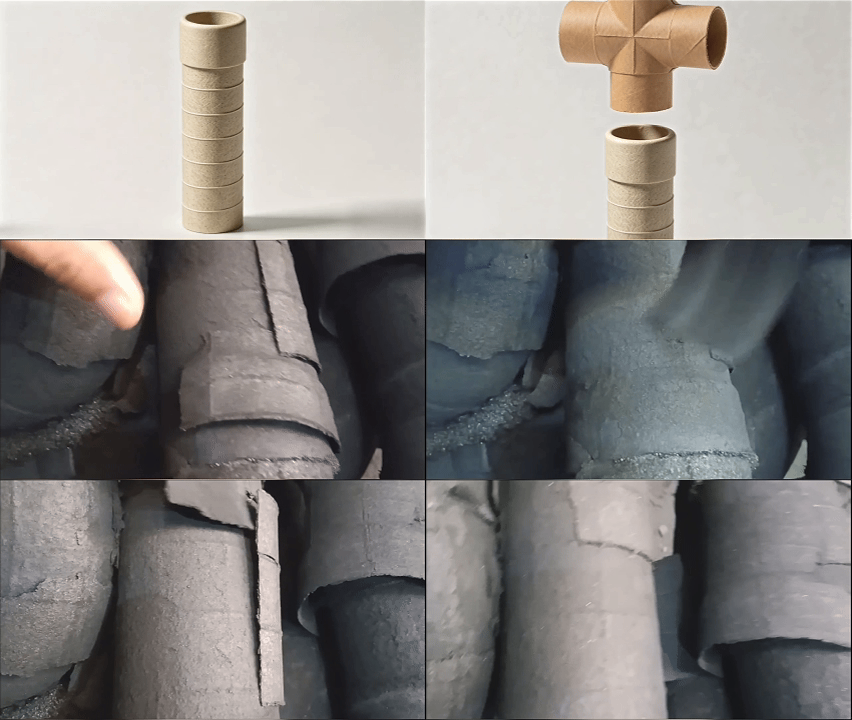
It adopts the same assembly method as ceramic tubes, made of modified refractory paper composite materials. Lightweight and freely cuttable on site, it supports rapid assembly via male-female connectors and generates almost no solid waste after pouring.
II. Technical Advantages of Paper Pouring Tube
Raw pulp mixed with paper fibers and refractory powder undergoes standardized full-process production including vacuum suction forming, drying & curing, precision cutting, multiple quality inspections and finished product packaging, delivering mature technology and stable performance.
Adopting upgraded fiber formulation and proven forming technology, Xinda Paper Pouring Tube implements strict raw material inspection standards and full-process quality control system. Many key performance indicators surpass ordinary domestic paper pouring tubes:
Improved production efficiency with stable dimensional accuracy. Tight fit between male and female joints saves time on cutting and assembly and shortens molding cycle.
Dense tube wall with outstanding high-temperature erosion resistance. Low erosion rate under continuous scouring of molten iron at 1500℃, resistant to perforation and collapse.
Standardized full-range quality control ensures consistent performance across batches and eliminates quality fluctuation.
III. Paper Pouring Tube VS Ceramic Pouring Tube
Lightweight for Easy Handling
Ceramic tubes are bulky and impose heavy workload during transportation and placement; Paper Pouring Tube greatly reduces weight and enables mass transportation by single worker.
Flexible On-site Cutting
Ceramic tubes are difficult and time-consuming to cut; Paper Pouring Tube can be trimmed to required size with ordinary scissors to adapt to complex runner layouts.
Modular Assembly with Male-female Connectors
Complete specifications including straight tubes, elbows and tees enable quick jigsaw-style assembly and drastically cut molding assembly time.
Easy Post-pouring Cleaning with No Damage to Sand Processing System
Residual materials become brittle and break upon impact, which can be discharged with dust removal systems. Hard solid waste is barely produced, preventing ceramic fragments from abrading sand reclamation equipment.
IV. Product Application Scope
Applicable casting materials: Gray iron, ductile iron, aluminum alloy castings
Allowable pouring temperature: ≤1480℃
Maximum pouring duration: ≤120 seconds
Maximum single ladle pouring weight: ≤10 tons
Process compatibility: Universally applicable for resin sand, water glass sand and lost foam casting, suitable for both large and small castings.
V. Key Factors for Industry Popularization: Catering to Industrial Upgrading Trend
The value of Paper Pouring Tube lies far beyond easy operation. It precisely complies with three major development trends of the foundry industry:
Increasingly stringent environmental regulations
Ceramic tube production consumes large amounts of energy with heavy subsequent waste disposal burden. Paper Pouring Tube features simplified production process, lower energy consumption, high raw material utilization rate and low rejection rate of finished goods. Hardly any hard-to-dispose solid waste is generated during application, complying with national policies of energy conservation, emission reduction and green casting.
Cost reduction driven by domestic substitution
Early imported Japanese paper pouring tubes were prohibitively expensive and restricted large-scale promotion. As domestic technology matures, production costs decline significantly, enabling foundries of all scales to implement replacement.
Continuous improvement of overall production efficiency
Lightweight design, easy cutting, rapid assembly and simple cleaning create cumulative benefits in mass production, directly translating into working hour savings and lower comprehensive manufacturing costs.
Compared with traditional pouring pipes, Xinda Paper Pouring Tube integrates multiple core strengths: light weight, easy processing, convenient assembly and eco-friendliness. Its light weight effectively lowers labor intensity during handling; on-site simple cutting enables flexible adaptation to various runner layouts; the modular male-female joint design supports fast splicing and assembly to greatly boost production efficiency.
Manufactured from modified special refractory paper fiber materials, it steadily withstands scouring of molten iron at nearly 1500℃, ensuring stable pouring without leakage or collapse. Residual materials turn brittle for easy cleaning after pouring with no hard solid waste produced. Balancing casting performance, production efficiency and environmental protection, it perfectly meets modern foundries’ demands for quality improvement, cost reduction, efficiency enhancement and low-carbon manufacturing.
Xinda devotes itself to supporting foundry gating systems, focusing on product R&D, production iteration and technological upgrading. With mature material formulations, advanced production equipment and comprehensive quality control system, we continuously supply the foundry industry with high-performance, eco-friendly and high-efficiency gating system solutions, empowering the green transformation and efficient development of the foundry sector.