



Application of Ceramic Foam Filters in Automotive Parts
2026-11-18 09:07The mainstream processes for automotive ferrous castings include green sand molding and precoated sand shell molding, with over 80% of production adopting green sand molding. Green sand production lines are divided into horizontal parting and vertical parting types. These lines feature fast pouring speed, which easily generates intense turbulent flow of molten metal inside the mold cavity, bringing more slag and high risk of sand erosion.
Ceramic foam filters perform dual functions of slag retention and flow stabilization. They convert turbulent flow into smooth laminar flow, greatly reducing defects such as gas entrapment, sand washing and reoxidation slag, and are suitable for mass production of automotive castings including engine blocks.
I. Product Advantages
Large-scale production base with stable batch supply and excellent consistency
High strength at ambient and elevated temperatures, impact resistant and low risk of slag shedding
High porosity and outstanding filtration performance
Compatible with cast steel, cast iron and non-ferrous alloys, serving high-end equipment sectors such as automotive, rail transit, wind power and aerospace

II. Comparison of Two Main Filter Types
1. Ceramic Foam Filter
Structure: Three-dimensional network structure for deep adsorption and fine filtration
Process: Polyurethane foam as the skeleton, coated with refractory slurry, followed by drying and high-temperature sintering. It involves complicated procedures and strict process control.
Performance: Capable of removing fine inclusions ≤20 μm with filtration efficiency above 90%. It integrates filtration, adsorption and flow rectification. It features good high-temperature stability and low cracking tendency, and is widely used for large castings.
Suitable for: Aluminum, copper and cast steel castings with strict impurity control requirements.
2. Straight-hole (Honeycomb) Filter
Structure: Aligned parallel channels for screening and low-resistance flow path
Process: Refractory material extruded or dry-pressed with molds, then air-dried and sintered at high temperature.
Performance: Dry-pressed versions deliver high dimensional accuracy, less sand scraping on green sand lines and low flow resistance. Its filtration and adsorption capacity is inferior to ceramic foam filters; inclusions smaller than the pore size may pass through.
Suitable for: Ductile iron and other scenarios dominated by large slag particles with moderate filtration requirements, prioritizing high throughput.
III. Production and Inspection
Fully automated production workflow: foaming, coating, drying, sintering, online inspection, deslagging and packaging. High-temperature performance tests are available to verify reliability under molten metal impact.
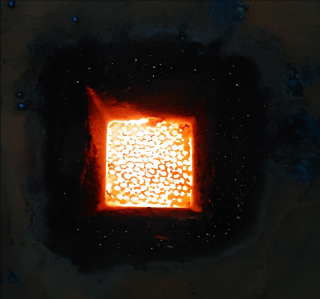
IV. Application Cases
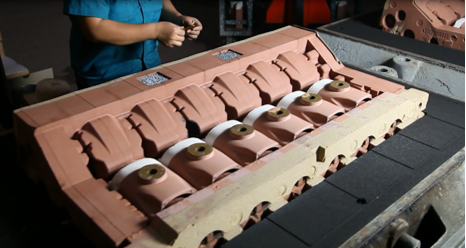
Case 1 Automotive Part – Engine Block
Material: RUT450 | Pouring temperature: 1380℃ | Pouring weight: 400 kg
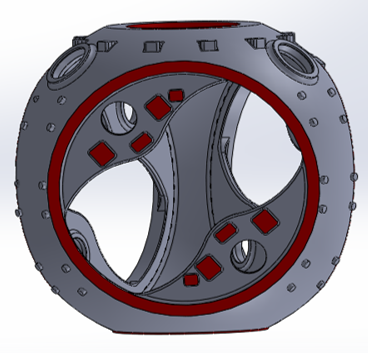
Case 2 Large Wind Power Casting – Hub (Extended application of the same filter series)
Material: QT350LT-22 | Pouring temperature: 1350℃ | Pouring weight: 13 t
Foam Ceramic Filters act as a critical auxiliary material for quality control of automotive castings. Proper selection and standardized installation can steadily cut casting defect rates, reduce subsequent grinding, inspection and scrap costs, and help automotive foundries achieve efficient and stable mass production.