



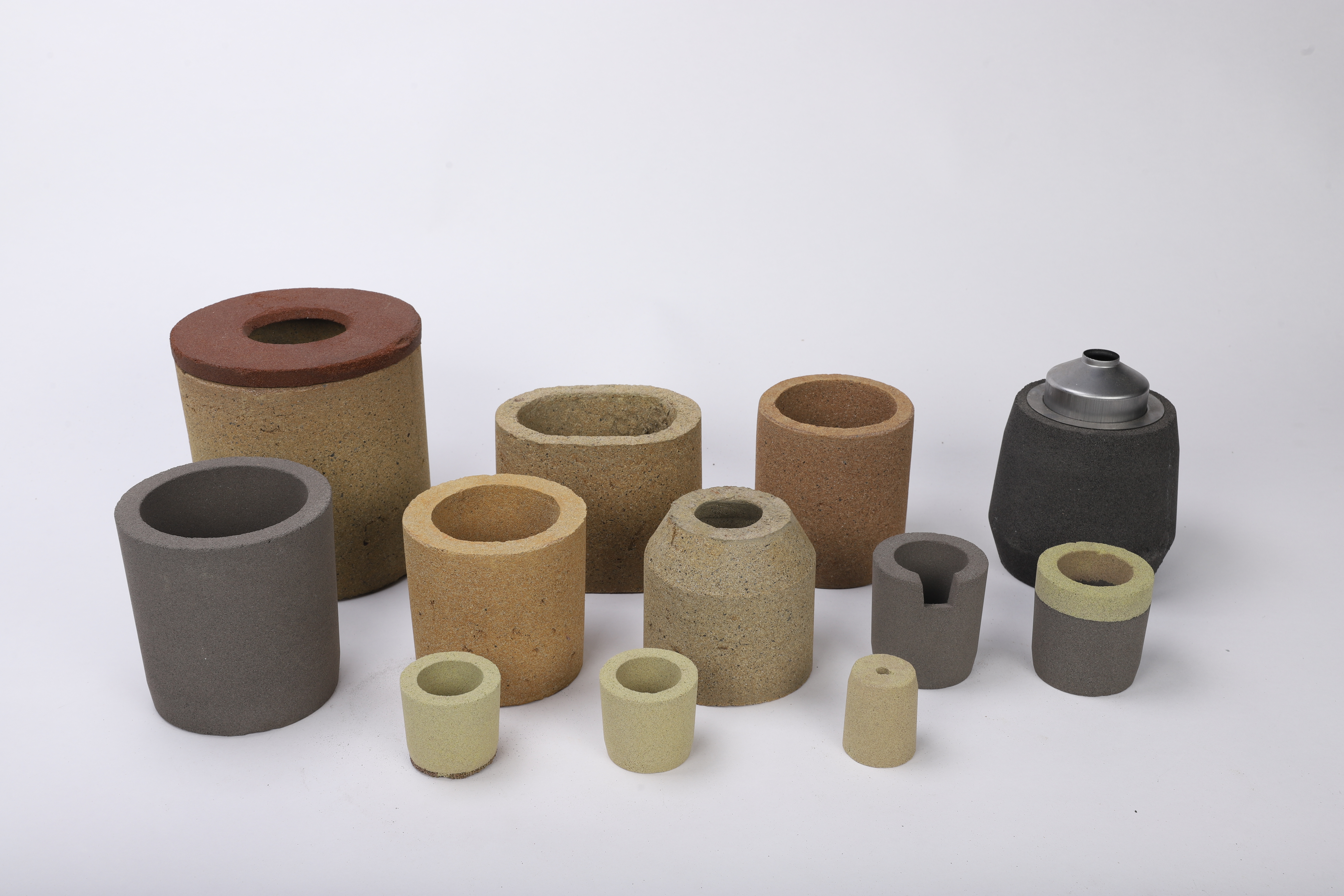
High-Precision Air Permeable Exothermic & Insulating Riser Sleeve
2026-05-29 10:10With technological advancement, green casting has become the mainstream of the foundry industry since the 21st century. Reducing energy consumption, raising process yield and overall finished product rate, and manufacturing high-quality eco-friendly castings are the common goals of the industry. While providing insulation for molten iron, insulating and exothermic riser sleeves can also deliver exothermic performance as required. They effectively increase the effective modulus of riser sleeves, facilitate feeding for castings and improve casting yield. Widely applied to automotive parts including wheel hubs, planet carrier, main reducer housings, turbine housings, steering knuckles, steering gear housings, crankshafts and axle housings, as well as various steel castings, the products successfully eliminate shrinkage cavities and porosity that are hard to solve with conventional risers, playing an irreplaceable role in optimizing casting processes.
1. Existing Problems
Defects such as blowholes, pinholes and porosity occasionally occur on castings. Besides the material of riser sleeves themselves, molten iron entrapment around riser sleeves is the primary cause.
Conventional riser sleeves adopt a tapered structure with a smaller top and a larger bottom, while the matched core has an opposite taper. This inevitably creates gaps between riser sleeves and cores. Some riser sleeves are also equipped with top vent holes. Molten iron easily penetrates into the gaps between riser sleeves and molds or the top of riser sleeves, partially or fully blocking the vent passages. As a result, gas inside the mold cavity cannot be discharged smoothly, leading to increased cavity pressure and incomplete mold filling of riser sleeves. Meanwhile, the riser sleeves are heated both internally and externally, causing unstable combustion speed and accelerated gas evolution and heat release. This disrupts the feeding timing for castings and gives rise to blowholes, pinholes, metal penetration and porosity. In severe cases, mold lifting occurs, resulting in severe porosity and dimensional out-of-tolerance.
Once molten iron seeps into the gaps between riser sleeves and outer molds and wraps around the sleeves, the entrapped material has to be removed manually, which increases cleaning workload and greatly reduces production efficiency. If the removal is incomplete, metallic aluminum contained in riser sleeve materials will mix into molten iron during remelting and raise the risk of hydrogen pinholes in castings. In addition, scattered iron scraps generated during the removal process pose major safety hazards to operators cutting the risers. What's more, molten iron entrapment also causes material waste and higher production costs.
2. Solutions
To address the above issues, Xinda has developed the high-precision gap-free and high air permeability insulating & exothermic riser sleeve. Its key advantages are as follows:
(1) High precision
Conventional riser sleeves feature high production efficiency and low cost, yet they are prone to deformation under external forces during molding and curing, with a typical dimensional tolerance of ±1 mm. Adopting a special molding process, our riser sleeves maintain a stable dimensional tolerance of ±0.3 mm, matching the precision of cores. With accurate overall height dimensions, they fit perfectly with sand compaction rings on upper molds. This prevents riser sleeves from cracking due to excessive interference which causes sand inclusion defects, and eliminates sleeve floating and subsequent molten iron entrapment.
(2) Reverse taper design
The opening end of the riser sleeve is designed with a reverse taper consistent with that of the core, enabling tight contact and nearly eliminating assembly gaps.
(3) High air permeability
3. Application Results
A foundry applied the 40/70 high-precision blind exothermic & insulating riser sleeves to its green sand production line for mass production. The average pouring time per mold was shortened by 2 seconds. Molten iron entrapment on riser sleeves and sand inclusion defects caused by cracked riser sleeves were completely eliminated. The overall rejection rate dropped from 3.2% to 2.1%, a reduction of 30%, and the process yield increased from 55% to 59%.
Since there is no longer entrapped material to remove, the number of operators for riser cutting was reduced from 15 to 12. No work-related injuries caused by flying iron scraps during cutting have been reported. The high-precision riser sleeves have brought remarkable economic benefits to the enterprise.
4. Conclusion
The high-precision gap-free and high air permeability insulating & exothermic riser sleeve effectively eliminates various defects caused by conventional risers, with comprehensive strengths summarized below:
Completely remove blowholes, pinholes, porosity, metal penetration and other defects induced by molten iron entrapment, and improve the overall qualification rate of castings.
No need to clean entrapped material, which boosts production efficiency. It also cuts molten iron waste, raises process yield, and avoids hydrogen pinholes resulting from aluminum mixed in recycled molten iron.
Eliminate safety risks brought by flying scraps during riser cutting.
Deliver excellent comprehensive economic benefits for foundries.