



New Choice for Veining Control — Xinda Organic Anti-Veining Additive
2026-10-28 10:28Veining is a frequent and troublesome defect in resin sand casting. It generally appears at corners and hot spots on the inner surface of castings in strip or even mesh patterns, which degrades surface finish, raises fettling workload and may cause scrapping for castings with intricate inner cavities where veining cannot be removed. Xinda organic anti-veining additive is specially developed to tackle this issue. Its performance has been verified through comparative pouring tests for steel, grey iron, ductile iron and copper castings.
Ⅰ. What is Veining and Its Harm to Castings
Veining is a typical defect for resin sand castings, mostly distributed at inner corners and high-temperature hot spots of castings in strip shape, or mesh shape in severe cases. It impairs casting surface quality and increases fettling work. Once veining occurs inside complex castings where cleaning is inaccessible, the casting will be rejected directly.
Ⅱ. Root Cause of Veining
Veining forms when molten metal penetrates cracks generated on the surface of sand cores/moulds. Silica sand grains expand thermally under molten metal heat. At 573℃, α-quartz transforms into β-quartz, bringing sharp volume expansion and creating thermal stress inside the sand core or mould. When thermal stress exceeds the high-temperature bonding strength of the sand core/mould, surface cracks occur and molten metal flows into these gaps to form veining. The higher the high-temperature strength and plasticity of the sand core, or the lower the thermal expansion stress, the lower the tendency of veining.
Ⅲ. Applicable Casting Grades and Resin Systems
Casting materials: cast steel, grey cast iron, ductile iron, cast copper
Resin binder systems: cold-box, hot-box
Ⅳ. Product Features
Improves flowability of sand core sand
Enhances surface quality of sand cores
Imparts colour to sand cores for easy traceability
Reduces fettling work and scrap rate
Lowers thermal expansion tendency of sand cores, thoroughly eliminates veining and flash on casting inner cavities; effectively inhibits sand core sintering and alleviates burn-on adhesion on inner cavity surfaces
Ⅴ. Comparative Test Results
Comparative pouring tests were carried out to demonstrate the improvement effect:
Casting without anti-veining additive: Obvious continuous strip veining appears at inner corners, which requires heavy fettling;
Casting with Xinda anti-veining additive: The inner surface is smooth, free of veining and flash. Sand cores produced with this additive show orange-red colour for easy identification and tracking in workshop handling.
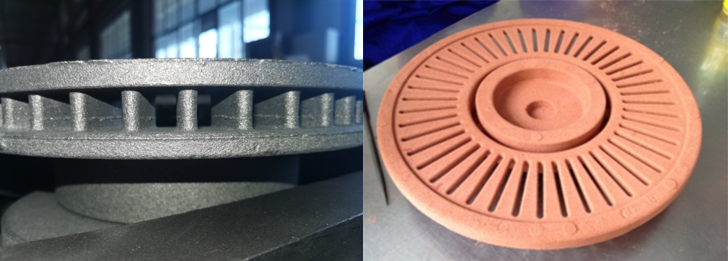
Validated by comparative pouring trials, Xinda anti-veining additive mitigates cracking risks caused by sand core thermal expansion from the source, addressing multiple inner cavity defects including veining, flash and burn-on. While optimizing sand core forming performance, the coloured sand cores facilitate on-site production control. Compatible with various mainstream resin sand processes, it helps foundries simplify post-processing and cut scrap losses. Xinda keeps advancing the R&D of supporting materials for resin sand casting, delivering stable and reliable defect-control solutions for casting manufacturers.